v1.96: The people behind the crowns
July 31, 2026 · Fallowborn devlog
Versions 1.93.4 through 1.96.5 turn distant crowns into living families, give the great houses of a realm durable political allegiances, and make every water crossing depend on the transport knowledge behind the host.
Fallowborn has always needed to know who wears every crown, even when the player never meets them. Until now, the game kept most of those rulers as compact realm and succession records. The interface borrowed the realm’s heraldry wherever showing a face would have required creating a full character. It was a practical hack that kept the world simulation and saves bounded, but it made distant politics feel like dealings between shields rather than people.
This release keeps the compact machinery underneath while filling the visible world with people and factions. A neighboring crown is now a ruler, consort, and line of heirs. A feudal court is now a set of houses with interests and influence. A sea route is now a logistical problem shaped by what the sovereign nation knows.
Crowns become living families
Every reigning dynasty now keeps its ruler, consort, and heirs as full characters. They have portraits, traits, skills, faith, culture, family links, and the same personal sheets used by people closer to the player’s household.
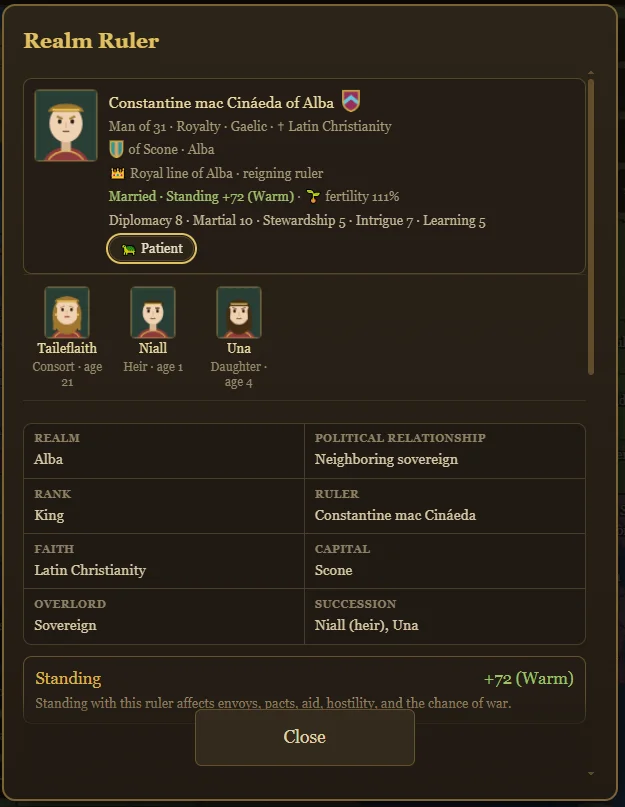
Opening a realm ruler now brings the living court into view. The ruler’s family appears beside the political summary, and each visible person can be opened through the same character system as friends, rivals, retainers, and kin. The Land tab’s Notable folk list also shows the ruler’s face instead of using the realm crest as a substitute for the person.
These are persistent identities rather than portraits generated for one screen. A child who inherits remains the same character, with the same family and relationships, when they take the throne. Consorts and heirs stay linked correctly through marriage, childhood, succession, and the cleanup of old generations.
The underlying court record remains bounded and save-friendly. Recent patches compacted how those courts are stored and added recovery for missing household members or malformed heirs, so the richer cast does not turn every save into an ever-growing census.
Courts take sides
Landed houses now form political blocs inside the court that matters to the protagonist. A ruler’s own house, direct vassals, and the player’s house when sworn there are grouped by the commitments and interests they actually hold.
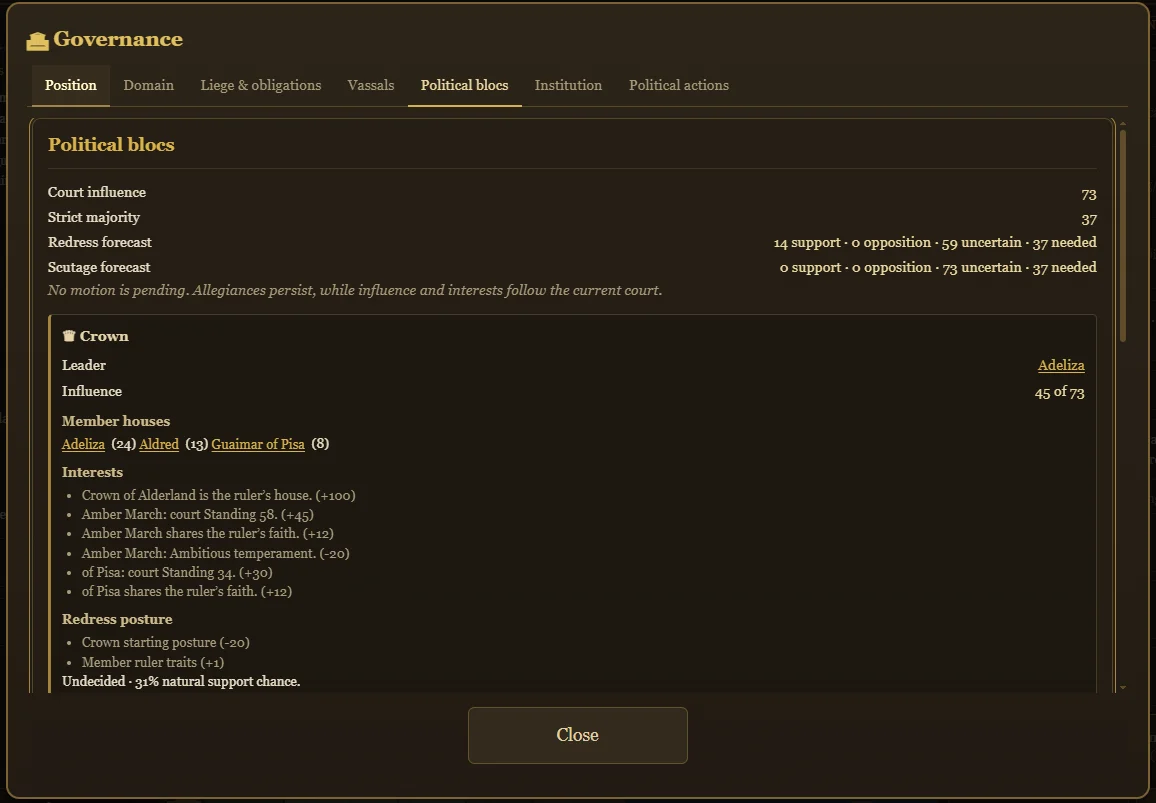
The Crown bloc gathers houses drawn by Standing, favor, shared faith, temperament, or a great office. Mercantile houses answer to guild rank, monopolies, enterprises, trade, and commercially important counties. Magnate affinities gather around powerful landed leaders through culture, faith, neighboring territory, and rank. A house with no strong tie remains Independent.
Governance and Network show the membership, leader, interests, and influence of each bloc. Influence comes from rank, directly held land, wider territory, and service in a great office. The result is a court that can be read before it is tested: the player can see which houses are bound to the crown, which move together, and which remain available to persuade.
For vassals in the Estates, the same blocs now decide motions. Redress and scutage forecasts show support, opposition, uncertainty, and the influence needed for a majority. Beginning a motion opens a campaign, one undecided bloc can be lobbied, and each bloc ultimately votes with one voice weighted by its influence. Allegiances persist beyond a single vote, but the annual review can move a house when its political basis changes.
The sea becomes a logistical route
Water links now use transport capacity instead of letting every army cross as though it were marching over a bridge. Local boats provide a small baseline. When a host is larger than the available lift, the crossing takes repeated cycles to move everyone across.
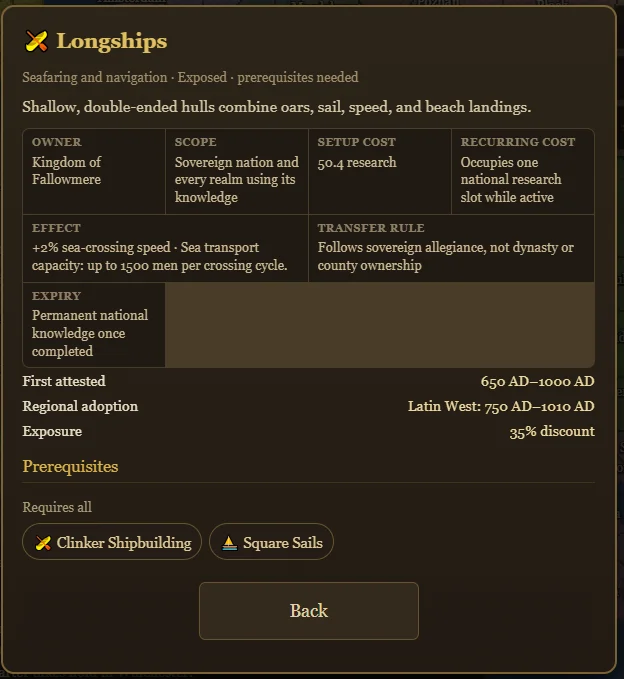
Seafaring knowledge and naval organization improve that problem. Technologies such as Square Sails, Harbor Works, Longships, organized naval levies, convoys, and later navigation raise capacity or crossing speed. Because technology belongs to the sovereign nation, vassal hosts use the transport knowledge of the realm whose banners and institutions support them.
The march order now reports what the player needs to judge the route: the number of water crossings, the limiting crossing, transport capacity per cycle, cycles required, and total travel time. A host preparing to cross is shown in that state on the map until the embarkation delay is complete. There is still no separate fleet to raise, but crossing water is no longer free of scale, place, or knowledge.
Interface and reliability notes
- Deeds layout: Daily focuses stay together, ongoing commitments no longer repeat the active focus, beginner path hints can be hidden, and the mobile focus shortcut opens at the start of the list.
- Household consistency: Family names, marriage terms, stepchildren, career histories, Guild Standing, and enterprise staffing now follow the same household rules through changes of work and residence.
- Court continuity: Throne succession, pledges, child accessions, consort links, Papal households, and yearly court cleanup received additional repair and retention work.
- Political interface fixes: Court ordering remains stable, Estates lobbying fits narrow screens, and political consequences begun while travelling apply to the correct home seat.
Bugs & ideas: GitHub issues · argue about balance: Discord · keep the barley free: Ko-fi