v1.93: Standing, schemes, and the work of rule
July 30, 2026 · Fallowborn devlog
Versions 1.84.2 through 1.93.3 make political relationships consistent and give landed rulers more ways to govern, scheme, and deal with neighboring courts.
Fallowborn has long remembered friendships, feudal loyalties, and diplomatic opinion in different corners of the game. This release joins them into one political memory, then builds on it with a new Governance ledger, political plots, active foreign policy, and lasting local consequences.
One Standing follows the person
Personal, feudal, and diplomatic relationships now use one Standing score. A ruler who is also a known character no longer has one opinion on a character sheet and another on a realm card. Gifts, personal attention, homage, petitions, council appointments, feudal demands, and diplomacy all change the same relationship.
That relationship now carries an explanation wherever it appears. Standing with a liege affects grants, service, and influence in the Estates. Standing with a vassal affects taxation, exceptional levies, council service, and resistance to revocation. Standing with a foreign ruler affects envoys, pacts, aid, hostility, and the chance of war.
Succession respects the person rather than the realm identifier. A known heir brings their own Standing to the throne, while an unknown successor begins with a clean political relationship instead of inheriting the predecessor’s friendships and grudges.
Governance puts the realm in one place
Territorial barons, counts, dukes, kings, and emperors now have a Governance sheet. Its compact sections cover Position, Domain, liege obligations or Independence, Vassals, Institutions, and Political actions without duplicating the systems behind them.
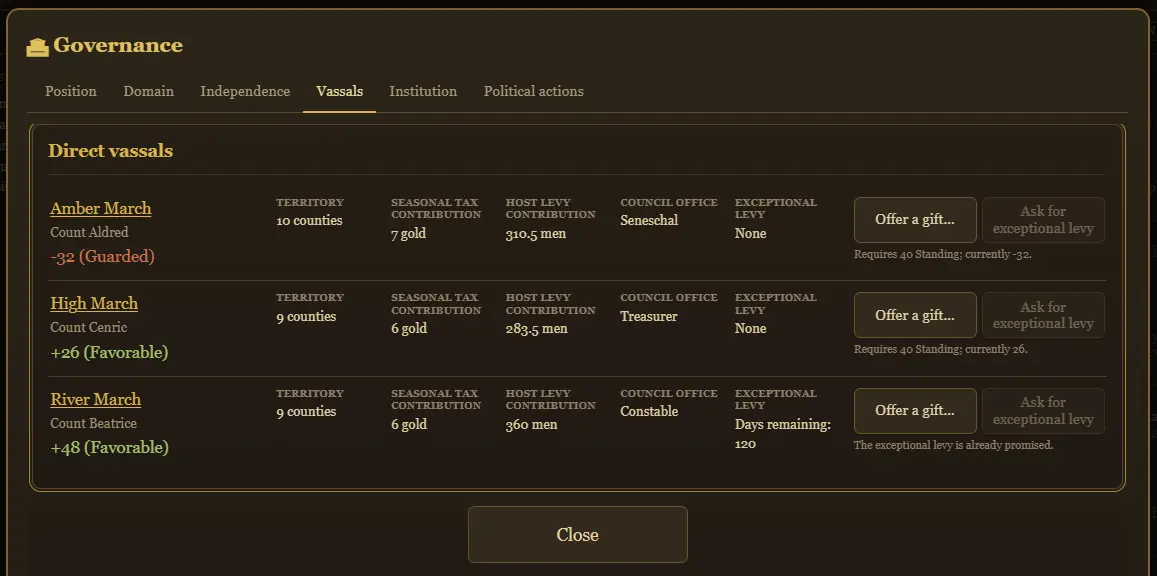
The ledger shows the realm and capital, demesne and domain pressure, vassal tax and levy contributions, council offices, exceptional service, institutional business, and active county consequences. Every row links back to the existing ruler, land, Council, Estates, and diplomatic controls, so the sheet acts as a political map of the current reign rather than a second rules screen.
The Vassals section makes the human relationships behind the realm especially visible. A ruler can compare each direct vassal’s Standing, land, money, levy contribution, council role, and temporary obligations before opening that ruler’s full interaction sheet.
Plots reach into politics
Scheming now reaches institutions, contracts, courts, and political rivals through five new plots. A vassal can bend a feudal obligation before the Estates. A guild insider can expose or exploit a monopoly. A sovereign can trace a dangerous councillor’s letters, while a landed ruler can intercept correspondence between neighboring courts. A personal feud can also be turned against a rival’s claim, office, council seat, or royal connection.
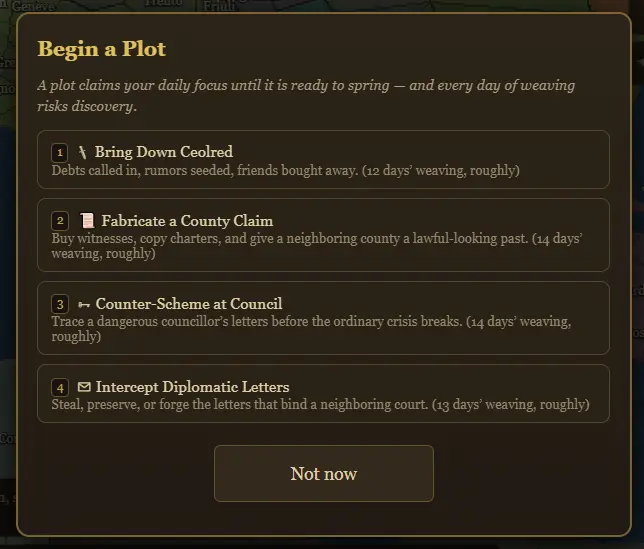
Each scheme keeps the existing plot rhythm: choose a valid, stable target, build power through the Scheming focus, risk discovery, and make a final decision when the plot matures. The result depends on what was actually targeted, so a letter, office, obligation, or monopoly remains the same object from the opening plan to the resolution event.
Diplomacy becomes a commitment
Independent rulers of county rank and above can now assign political attention to neighboring courts. Improving or provoking a relationship is an ongoing direction, not a one-day button. It changes Standing each season and remains in force until the ruler replaces it.
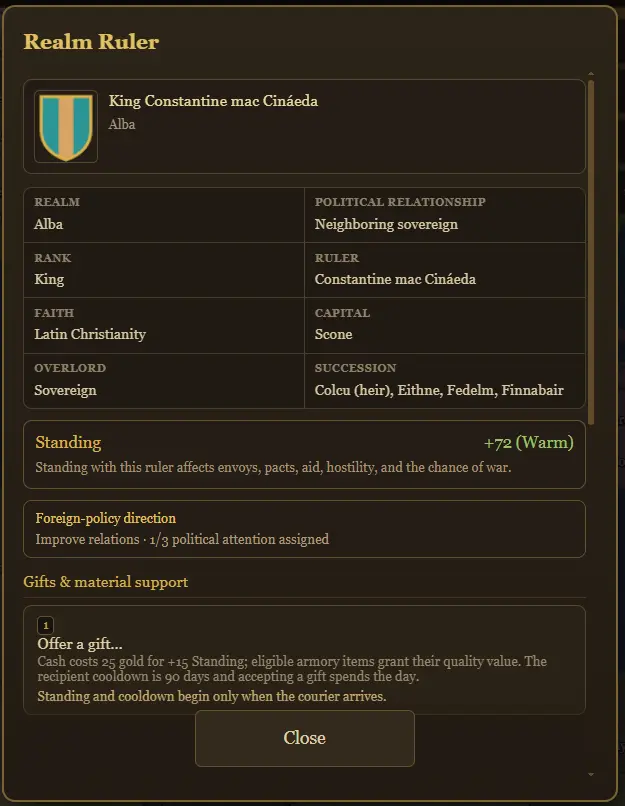
Rulers can turn warm relations into pacts, and kings or emperors can offer a defensive alliance once Standing reaches the required threshold. Alliances bring abstract defenders when a member is attacked, while pacts prevent either side from declaring war. Both are relationships between living rulers, so a succession opens a new diplomatic chapter rather than silently preserving the predecessor’s bargain.
New diplomatic events follow those directions and agreements. Neighboring courts may seek border arbitration, safe conduct, pact renewal, alliance concessions, subsidies, or a new compact after succession. Friendly and hostile policies can also provoke their own incidents, and AI crowns can pursue alliances under the same broad constraints as the player.
Decisions leave marks on the land
Council and Estates stories now leave visible county consequences behind. A market charter can improve local trade, contested tolls can burden it, a levy exemption can reduce service, and an aggressive muster can exhaust the countryside. Patrolled roads make travel safer, while a settlement grievance can outlast the meeting that created it.
These effects appear on Land and Governance, modify the county while they remain active, and stay with the place when ownership changes. Later political business can answer earlier failures: redress may replace a grievance with confirmed custom, while a disputed toll settlement can become a recognized market charter.
Smaller additions, interface, and patch notes
- Household match planning: The Household Plan has an optional descendant match assistant. It recommends sounded-out families within saved station, dowry, and expense limits, but never makes a pledge, spends money, or advances the day.
- Equipment planning: Every managed character’s Equipment sheet can preview and apply the strongest legal outfit available from the family armory. The review shows each exact item change before anything moves.
- Land purchases: A freeholder can buy every remaining plot needed for a manor-sized holding in one reviewed market purchase.
- Offline play: After one complete visit, the hosted game prepares an offline copy and can be installed in browsers that support web-app installation. The self-contained itch.io and downloaded builds continue to run directly.
- Interaction layout: Character and ruler sheets now group actions into consistent cards showing commitments, costs, consequences, and blocked reasons.
- Large-list layout: Work & Enterprises and Network sections gained counts, collapsible groups, attention filters, and search. Household standards, work outfits, and permanent property use denser catalogue rows, while Governance now uses compact section tabs and a tighter vassal ledger on desktop and mobile.
- Standing and Governance fixes: Ruler Standing now stays synchronized through older saves, character materialization, and succession. Governance remains usable at narrow widths and rebuilds missing derived realm state when loading earlier saves.
- Work and intrigue fixes: Work & Enterprises returns to the exact managed enterprise after an assignment. Long-list browsing no longer loses the current selection, and a fresh game starts with stable intrigue state.
- Regression coverage: Browser tests now cover unified Standing, Governance, interaction cards, descendant matching, equipment planning, political plots, diplomacy, persistent county consequences, list navigation, offline behavior, and the related save migrations.
Bugs & ideas: GitHub issues · argue about balance: Discord · keep the barley free: Ko-fi