v1.75: Victory leaves a mark
July 27, 2026 · Fallowborn devlog
Versions 1.72.2 through 1.75.1 make victory, reputation, and local decisions leave visible consequences.
A great holy war no longer ends with its conquests silently assigned. Characters can now acquire traits through their deeds, counties can remember recent policy, and an army can carry the effects of its campaign commitments. Together, these systems make the aftermath as legible as the action that caused it.
Victory has claimants
Joining the attacking side of a great holy war now begins with a vow. A volunteer promises four, eight, or twelve seasons of service and declares what they hope to gain: the sovereign crown, custody of a sacred site, a particular duchy or county, or honor alone. A landed claimant can also name a close relative to receive land in their place.
The promise persists through succession and can be renewed if the war outlasts it. Leaving before the term is fulfilled costs twice the usual piety and prestige, records a broken vow, and weakens the character’s standing in future settlements.
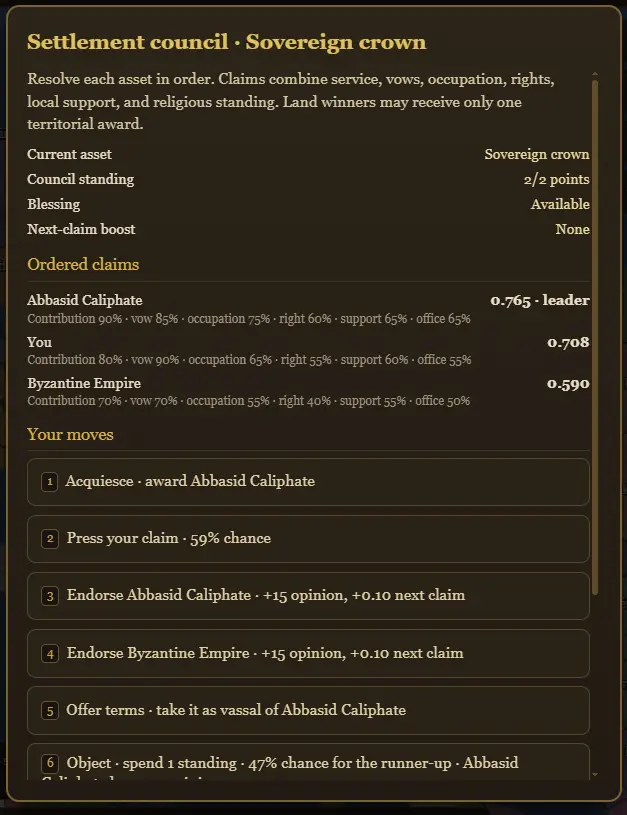
When the attackers win, the settlement council considers the sovereign crown first, then captured sacred custody, complete duchies, and individual counties. Each claimant receives a score based on military contribution, the vow they made, occupation, legal right, support from other participants, and religious office.
The leading claimant does not act alone. Participants can press their own claim, endorse another claimant, offer vassalage or gold in exchange for an award, object to the proposed winner, or acquiesce. A player who holds the relevant religious office can also bless the leading claim. Endorsements build relations and strengthen the recipient’s next claim, while objections spend limited standing and may elevate the runner-up.
All awards are applied together at the end of the council. Existing local rulers can be confirmed beneath a new liege, newly landed AI beneficiaries found campaign cadet houses, and the player can accept or decline personal land. Custody of a sacred site remains separate from land and grants piety while it is held.
Victory now produces a negotiated political order rather than an automatic transfer.
A life has layers
Traits are now grouped by what they represent:
- Disposition covers temperament and instinct.
- Formation covers education and upbringing.
- Reputation covers what a character has become known for.
- Condition covers lasting physical states.
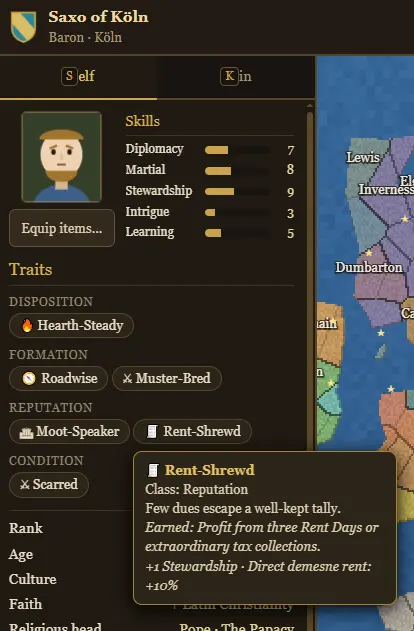
Five new reputation and formation traits can be earned through play. Winning Estates votes can produce Moot-Speaker. Completing journeys through distinct places can produce Roadwise. Sustained military service can produce Muster-Bred. Profitable rent days and extraordinary taxes can produce Rent-Shrewd. Supportive outcomes with a spouse or child can produce Hearth-Steady.
These are not labels awarded by a single choice. Each has a hidden progress track tied to repeated conduct, and each carries a mechanical benefit that matches its history. Moot-Speaker improves assembly persuasion and positive Common Voice gains. Roadwise shortens ordinary travel and reduces road incidents. Muster-Bred strengthens direct levies. Rent-Shrewd improves demesne rent. Hearth-Steady improves positive Regard gains with close family.
Trait progress belongs to the current life and clears on succession. The heir begins with their own history to make.
Consequences stay on the map
Fallowborn now has a general system for temporary county and campaign modifiers. The immediate set covers famine relief, local custom, and great holy-war service.
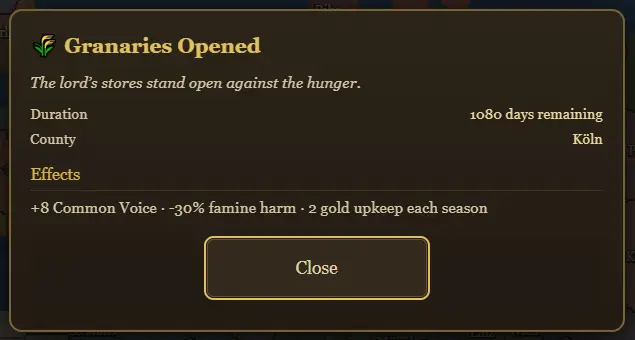
Opening granaries during famine reduces local harm and raises Common Voice, but requires seasonal upkeep. Confirming local custom gives a county a decade of greater Common Voice and lower unrest at the cost of levy strength. These effects belong to the county, so they remain if the land changes hands. Their upkeep is only charged while the county is held directly.
An Oathbound Host uses less supply and earns more war contribution, but makes an early withdrawal more costly. Fractured Command is also available to authored events and scenarios, slowing marches, worsening battle odds, and risking seasonal desertion.
Modifier chips appear wherever their scope matters. Opening one shows the source, remaining duration, costs, and exact effects. Expired modifiers are removed automatically, and the whole state persists through saves.
The purpose is simple: important decisions should remain visible after their event text closes.
Patch notes
- Marriage residence and living abdication: A tier-three or higher protagonist who marries the exact target of a relationship visit in that character’s county can move there and continue as landless gentry. They may abdicate immediately, continue as the lawful heir while the former ruler remains alive, or defer the decision until the journey ends.
- Great holy-war clarity: Settlement descriptions, temporary modifier labels, and Roadwise guidance have been revised for clearer scope and consequences.
Bugs & ideas: GitHub issues · argue about balance: Discord · keep the barley free: Ko-fi