v1.72: Knowledge, trade, and distant ties
July 27, 2026 · Fallowborn devlog
Versions 1.60.2 through 1.72.1 make the map matter away from conquest. Knowledge now belongs to nations and passes between them through historical and political contact. Merchants can choose a market, risk their own capital, and follow the road themselves. Friendship and courtship now depend on where people live, not only whether their names appear on the same sheet. A distant ruler can become a personal relationship, while gifts crossing sovereign borders travel rather than teleport. At home, a family has more ways to spend, educate, provide, and plan across generations.
A realm learns together
Technology now belongs to sovereign nations rather than individual rulers or dynasties. The catalogue contains 180 innovations across agriculture, crafts, commerce, learning, government, warfare, and seafaring. Each can unlock concrete buildings, enterprises, schooling, contracts, military practices, or other rules, while many also change the numbers behind research, trade, administration, health, movement, siegecraft, and army composition.
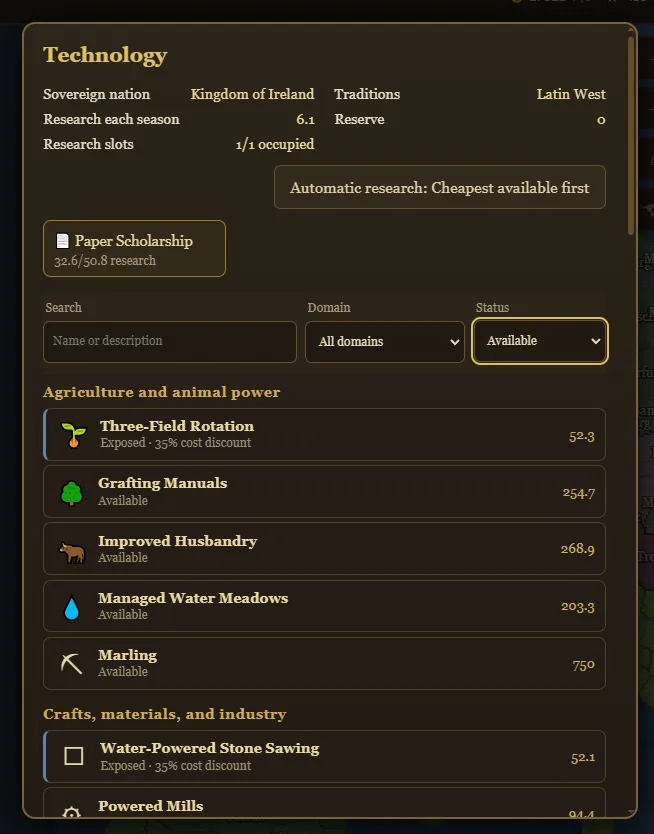
Vassals use and contribute to their sovereign’s shared knowledge. If a realm changes fealty, it begins using the knowledge of its new sovereign without destroying the old national record. A restored or newly independent realm can therefore recover what it once knew. The Land tab shows a compact technological development rating for comparison, while each technology sheet names the effects that actually reach play.
The 867 and 1066 starts no longer assume that every part of the map learned the same things at the same time. Byzantine, Islamic, Latin, Nordic, Slavic, Steppe, and other traditions begin with different completed and exposed knowledge. Prerequisites are firm, but history is a cost curve rather than a calendar lock. Researching centuries ahead is possible and expensive. Falling behind the historical adoption window makes a project cheaper.
Exposure makes that catch-up process political. A neighboring realm, ally, wartime opponent, shared tradition, or broader faith network can permanently expose a nation to an innovation and reduce its research cost. War is especially good at transmitting military practice. Knowledge can cross a border long before a realm has the prerequisites to put it to work.
Every sovereign realm builds one seasonal research pool. Development, completed innovations, and Patronize Scholars add to it, then active projects share the total. Later knowledge can open second and third project slots. Sovereign players may choose projects directly, automate the cheapest available path, or favor one of the seven domains. A landed vassal with enough favor can instead spend coin and influence to press one innovation on the liege’s agenda.
Merchants choose the road
Adult freeholders and gentry can now found a trade venture rather than only finance somebody else’s partnership. The household chooses a stake of 10, 20, or 50 gold, selects a reachable developed market, and pays the route overhead separately. Better transport shortens the journey and lowers that overhead without reducing the capital at risk.
The venture can be dispatched while the protagonist remains at home, or accompanied through the existing overland travel system. A dispatched venture resolves after at least 90 days and can survive promotion or succession to pay the household’s current head. An accompanied venture uses the actual road, its encounters, the destination stay, and the return journey. Either way, the household chooses a cautious or bold strategy before leaving.
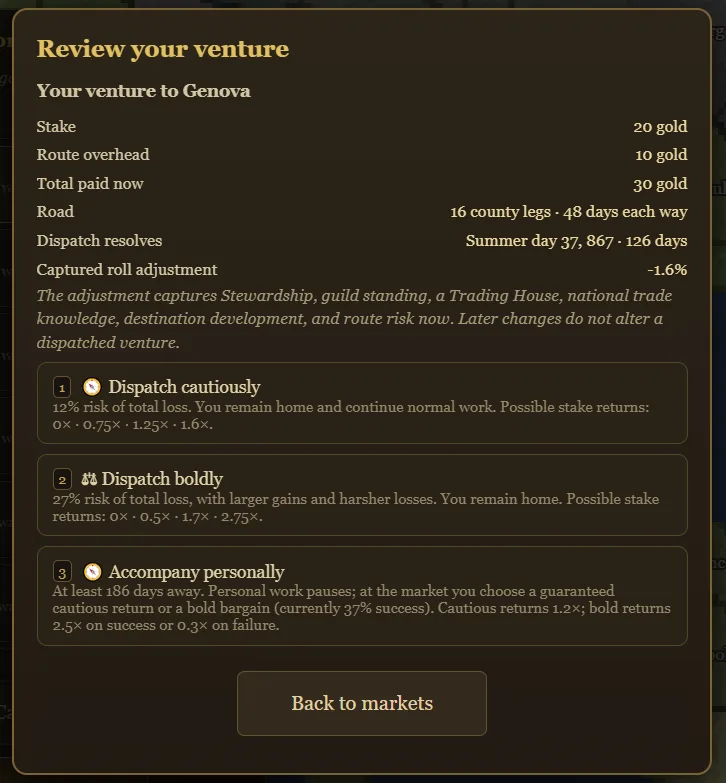
Stewardship, guild privilege, a Trading House, national trade knowledge, and a richer destination all improve the prospects. Long routes add risk. The result may lose the entire stake, recover only part of it, return a normal profit, or produce an exceptional success. A player who travels with the venture can bargain personally, but also accepts the dangers that already belong to a life on the road.
Trade knowledge now reaches feudal politics as well. Once a sovereign nation completes Guild Charters, a Craft or Trade guildmaster with sufficient standing and favor can petition the local lord or direct liege for a temporary monopoly. The privilege raises matching enterprise output and lasts longer when granted by a higher ruler. Barons and greater rulers can issue one local monopoly of their own, collecting a fee and additional toll revenue while losing popular opinion. A charter is valuable because somebody else must bear its cost.
A household lives by the season
Commoner households can now maintain standards beyond bare subsistence. Board, wares, quarters, luxuries, transport, and profession-specific work outfits each advance one purchased level at a time. A level has a setup price and a recurring seasonal cost, with higher ranks and technologies opening better options.
Those choices affect more than a prestige number. Better food and quarters can protect health, books and writing materials can help education, transport can reduce travel time and cost, and work clothes or tools can improve the output of matching household labor. If the purse cannot maintain everything at the season boundary, comforts lapse without creating debt. The family must buy them again if its fortunes recover.
War now reaches the same ledger. A household inside a realm at war pays more for basic necessities, and a raised host has seasonal logistics based on its live composition. Levies are cheap to keep in the field. Archers cost more, while cavalry and men-at-arms cost more again. Hired companies retain their contracts. Casualties, reinforcement, a shattered host, and a fresh muster therefore change the bill instead of leaving one abstract war charge.
The managed family has widened too. Every living unmarried grandchild now receives the same education, work, equipment, upkeep, health, and arranged-marriage controls as a child. A marriage ends that residence and returns assigned equipment to the family armory.
Gentry households whose sovereign has Scholarly Networks can send young descendants to a Noble Academy. It teaches every education focus, charges by the term, and brings academy stories about patrons, public disputations, family rivalry, books, dress, and reputation. Its instruction is strong, but time away also carries a small cumulative mortality risk. Education remains an investment in a particular child rather than a permanent household bonus.
Distance matters between people
Characters now have an authoritative residence. Household members and retainers live at home, foreign notables remain in their county, and royal children live at their realm’s current capital. Personal attention and courtship advance only while the protagonist shares that place. Work, study, deeds, and a destination stay can continue around the relationship, but time spent outbound, returning, or elsewhere pauses it.
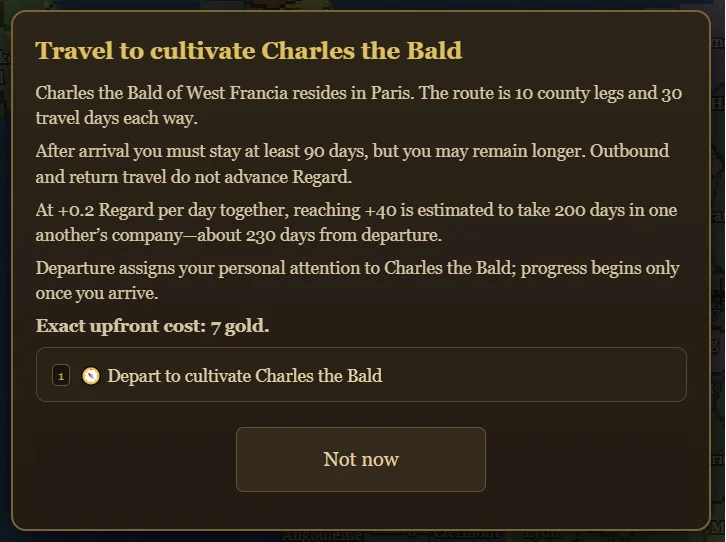
A distant contact’s sheet now offers a targeted visit. The game previews the route, cost, travel time, minimum stay, and estimated time needed to reach the relationship threshold. On arrival, attention begins and the existing travel system supplies personal visit stories. The traveler must stay at least 90 days before returning, and can visit again later if more time together is needed.
Remote courtship uses the same rule. Beginning a suit with an ordinary or royal candidate in another county begins the journey and courtship together, then Regard starts at the candidate’s residence. A royal court moves with its capital. Gifts, a proposal once the relationship is ready, and the formal naming of a qualified friend can still cross distance, but the quiet daily work of becoming close now requires presence.
AI realm rulers ordinarily remain compact political identities rather than filling the world with complete characters. Their realm sheet now offers Cultivate relationship, which quotes an ordinary journey to the current capital and requires the same 90-day minimum stay. Choosing it generates that ruler as a full character, with personal friendship, rivalry, courtship, marriage, and spouse dealings where applicable. Their heraldry and identity card then opens the full character sheet directly.
Every character and ruler sheet also offers an explicit gift. Coin or an eligible family-armory item improves Regard, Opinion, or Favor according to the recipient, and the same person can receive only one such gift every 90 days. Items leave the family collection permanently, turning an inherited object into a deliberate piece of social capital. A gift inside the household’s sovereign realm remains immediate. Across a sovereign border it leaves the permanent home by courier, shows its expected arrival or return, and changes standing only when it reaches the intended recipient. If succession or death makes delivery impossible, the courier returns the exact coin or item.
Patch notes
- Great holy war transitions: Crusades and Jihads now announce the head of faith’s call and the gathered sovereign hosts’ march through dedicated wartime events.
- Technology pacing and clarity: Research projects now show concrete effects and completion estimates, saved games open the technology screens reliably, every prerequisite innovation provides a modest benefit, and the later historical curve has been lengthened. Automatic research is faster to process and refills open slots after every completion.
- Travel performance and continuity: Destination and trade venture screens now calculate large route lists faster, while relationship visits and ruler standing labels remain consistent as circumstances change.
- Land information: The Land tab now shows county economic development, sovereign technological development, the county holder, direct vassals, and the liege chain.
- Interface cleanup: Desktop panel tabs use compact keycap labels. Mobile tabs use full names, dialogs keep complete safe-area framing and consistent bottom-centered exits, equipment headings fit narrow screens, birthplace selection advances directly, and dragging a fully zoomed-out map remains stable.
Bugs & ideas: GitHub issues · argue about balance: Discord · keep the barley free: Ko-fi