v1.60: Crusades and Jihads take the field
July 25, 2026 · Fallowborn devlog
Versions 1.59.0 through 1.60.0 let a head of faith call rulers, vassals, and common soldiers into one continental campaign. Crusades and Jihads gather for months, put many sovereign hosts into two hostile camps, and ask those armies to fight for a fixed set of sacred and territorial objectives. Victory does not hand the whole prize to one attacker. Service is measured, occupied land is partitioned, and the households that bore the campaign decide what grows from it.
A head of faith makes the call
Catholic Crusades can begin from late 1095 when Jerusalem is outside Christian rule. Sunni Jihads can begin from 1105 when Jerusalem, Baghdad, Mecca, or Medina is outside Muslim rule. The office must have a living Pope or Caliph to issue the call, joining the religious leadership system introduced in v1.58 to the wars now fought in its name.
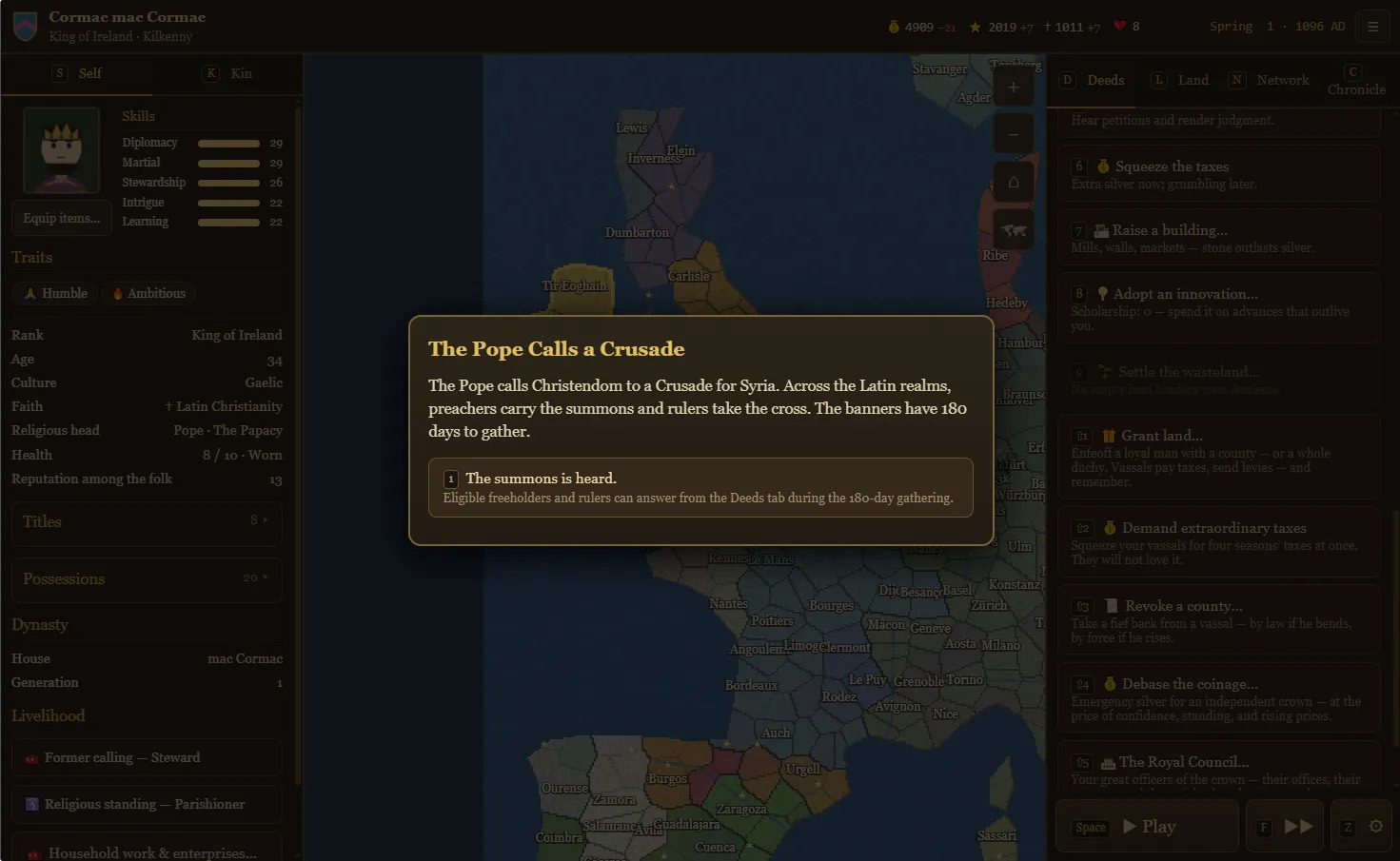
Every call begins with 180 days of preparation. Sovereign attackers volunteer, rulers who control the target land are committed to its defense, and other eligible sovereigns can rally to the defending religious camp. A weak or leaderless call can collapse before the armies depart. Once the campaign launches, however, it belongs to its participants and can continue even if the office that called it later falls vacant.
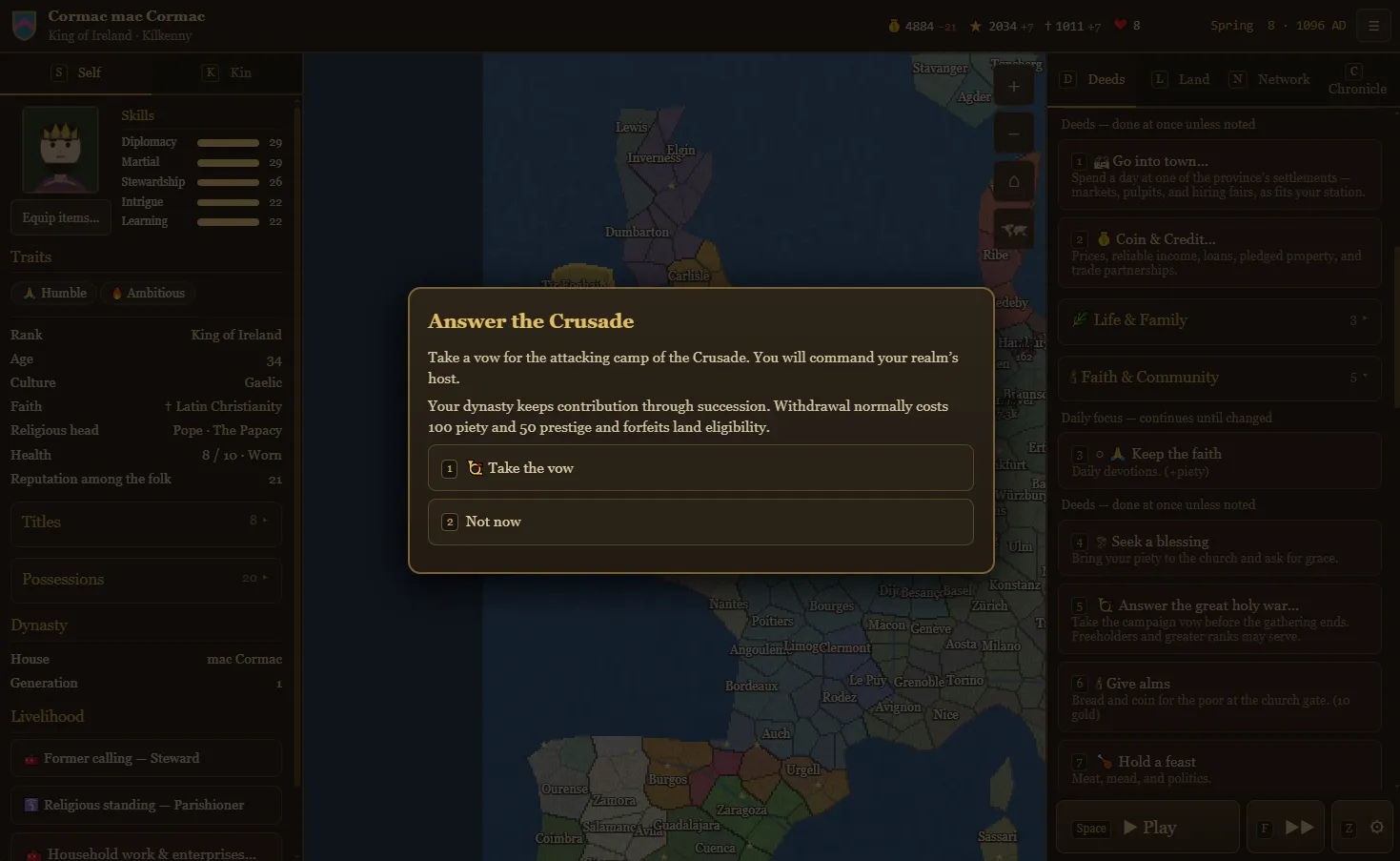
Adult freeholders and every higher station can answer from the Deeds tab. Independent sovereigns bring and command their own field host. Vassals and unlanded volunteers instead join a personal expedition, serving through campaign events while their liege’s army carries the banner. A ruler already committed to another war cannot promise the same host twice.
Two camps take the field
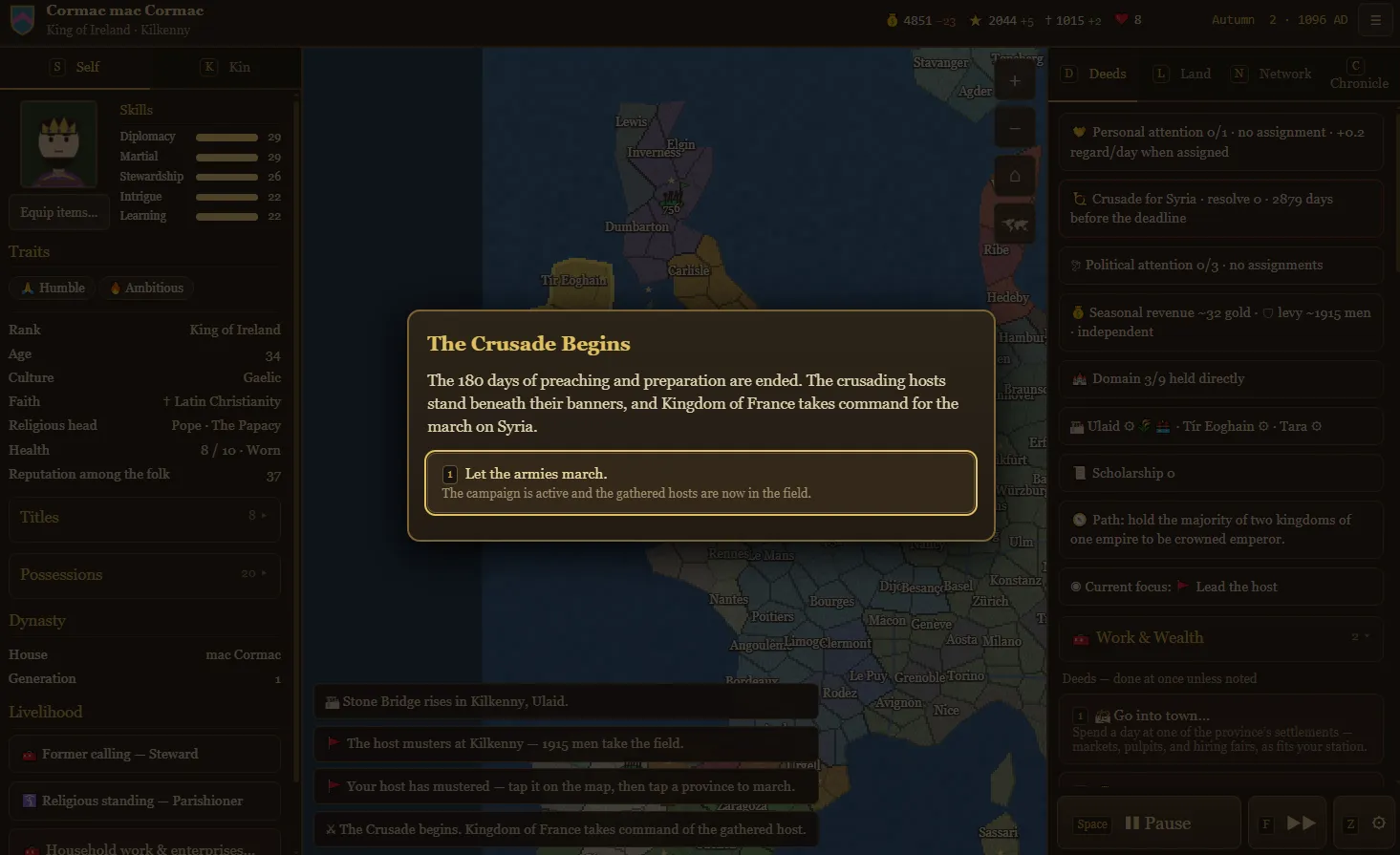
A great holy war is one global campaign alongside the ordinary wars already reshaping the map. Every sovereign keeps a separate host, allies in the same camp move without fighting one another, and opposing camps clash whenever their armies meet in a county. A single battlefield can draw together rulers who would otherwise have no shared border or alliance.
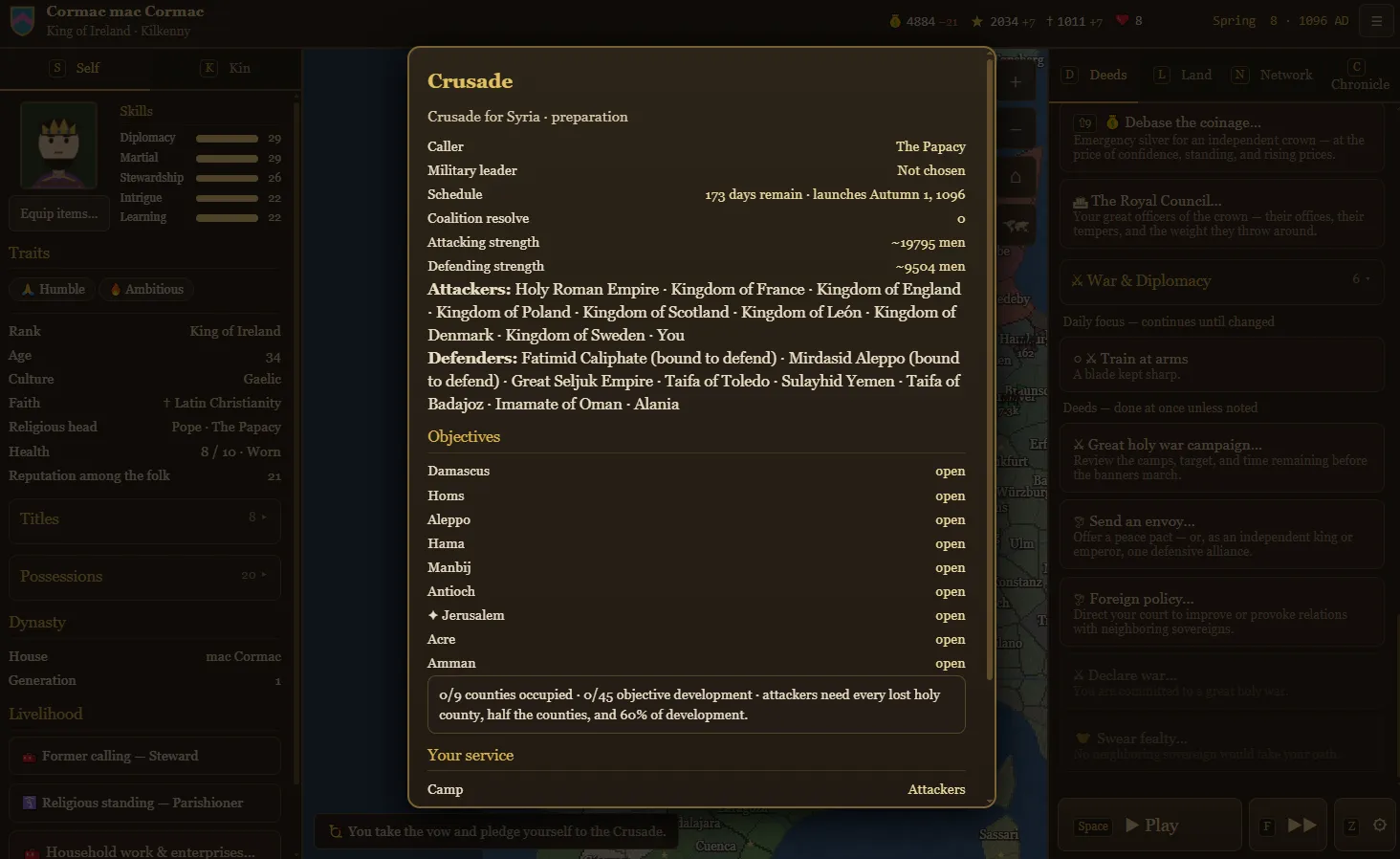
The objectives are frozen when the call is made. They do not change owner each time an army reaches them. Instead, friendly hosts standing uncontested in a target county build a temporary occupation, with larger forces working faster against richer and more difficult places. Defenders can interrupt the siege, win the field, and recapture occupied land. Progress left unsupported begins to decay.
Attackers have eight years to occupy every lost holy place, at least half the target counties, and 60 percent of their development. Battles and occupations also move the campaign’s resolve. The defenders win if they break that resolve, outlast the deadline, or leave no attacking sovereign in the field. The result comes from armies that marched and held ground, not an abstract yearly dice roll.
Service decides the settlement
Every battle, occupation, recapture, season under arms, and personal expedition adds contribution. Field winners earn more when the enemy suffers heavily, while siege credit is divided among the friendly strength present. The record belongs to the player’s household rather than one character, so a death does not erase years of service. A successor must renew the inherited vow before earning more or remaining eligible for land.
When the attackers win, only occupied counties enter the settlement. Contribution orders the claimants, sacred or highly developed land anchors the new realm, and complete duchies and crowns require both enough service and the usual de jure foundation. The result may be a new cadet kingdom, a duchy or county, land joined to an existing sovereign realm, or a relocated vassal demesne. A player can also decline land and take piety and prestige instead.
That partition gives every campaign a second history after the fighting. A distant sponsor may establish a cadet ruler without abandoning its old realm. A vassal may leave home for a won demesne. A sovereign may unite the prize with an existing crown. The war ends, but its map and families keep moving.
Patch notes
- Life by station: Events, choices, tasks, and livelihoods now follow five societal roles from serf to crowned ruler. Gentry deal with rents and guest-right, lords hear poachers and inspect reeves, crowned rulers face progresses and court precedence, and high-born children learn through tutors, falconry, and the high table. Rising into the landed ranks also turns an old hands-on career into a former calling while household businesses and staff continue.
- Childhood balance: Each station above serf slightly reduces childhood mortality for the household’s own children and gives them a yearly chance to grow hardier. A childhood fever now offers a wise woman, trained physician, or renowned physician at increasing cost and success, alongside free prayer.
Bugs & ideas: GitHub issues · argue about balance: Discord · keep the barley free: Ko-fi