This update expands warfare beyond a single campaign. Select several claims together, fight separate opponents at the same time, and confront rebel armies at home. Historical foundations add regional goals for rulers.
Multi-claim wars
War target selection now lets you combine compatible territorial claims against the same opponent. Choose counties from the list or directly on the map, then review the selected claims and the justification before declaring.

A combined claim war requires you to occupy every selected objective together. Occupation does not immediately transfer ownership; the counties change hands when the campaign is settled.
Concurrent campaigns
Your realm can fight several campaigns at once. Open Campaigns in Deeds to inspect each war and assign hosts. The campaigns share your military resources, so opening another front does not create another army. Ruler sheets list the opponents and objectives separately.

Realm laws also govern internal and external vassal wars. A liege can require permission or prohibit them. Declaring unlawfully can bring a demand for peace; compliance ends that campaign, while refusal permits enforcement.
Armed commons rebellions
Popular support now belongs to individual counties and affects their taxes and levies. Refused commons demands can lead to warnings and local unrest. At sufficiently low support, the commons muster rebel hosts that besiege their home county and can spread into neighboring hostile counties.

Inspect support and revolt status in Land. Concessions, negotiation, suppression, and military action give you ways to respond, with costs reflecting the affected counties. Armed revolts do not expire on their own. Unjust wars add local support penalties that stack and recover over time, so repeated aggression can leave trouble at home.
Historical foundations
Count-or-higher rulers can open Historical ambitions in Deeds to establish Normandy, Norway, England, or Sicily. Available cards depend on your region and, for Normandy, Norse culture. They show the required land, political conditions, recognition costs, and rewards.
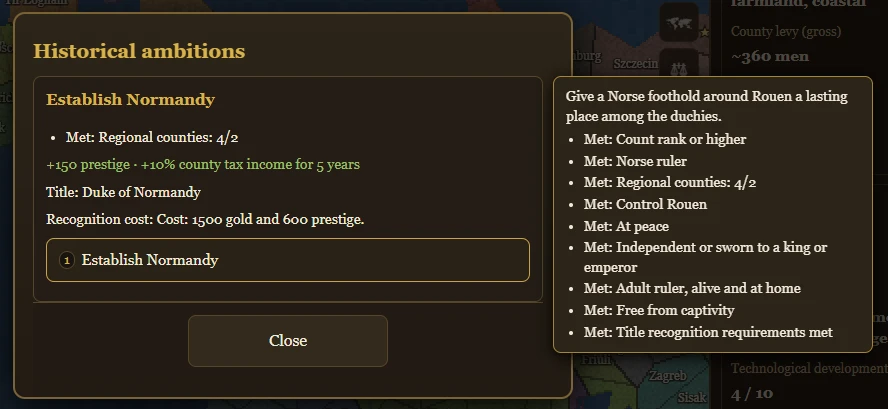
Founding a realm can raise your title and grants prestige plus a temporary regional tax or levy bonus. The Chronicle records the founder. AI rulers can complete these foundations too.
Performance and saves
Seasonal fast-forward does less repeated work when processing armies, recruitment, supply, sieges, and rebellions. Annual population and enterprise updates also reuse calculations, while Chronicle rendering and save serialization avoid rebuilding unchanged records.
Save slots now prefer IndexedDB, giving long campaigns more room than the older browser storage limit. Existing saves migrate automatically after a successful write, with localStorage retained as a fallback. Manual save confirmation waits until the write finishes. Downloaded save files remain available for backups and moving between devices.
The save controls support deleting individual slots or all saves, and show storage usage. To limit long-term save growth, unrelated routine world notices retain the preceding five complete calendar years. Family and realm records, decisions, and major outcomes remain permanent; the Chronicle viewer reports how many routine notices were removed.
Other changes
- News filters: Settings > Notifications lets you choose family, realm, or wider-world news. These filters change visibility without suppressing decisions.
- Decision outcomes: Promotions and other significant decisions show clearer results with actual costs and gains. Time stays paused after events by default.
- Family and work: Family trees avoid duplicate branches. Work and enterprise lists show clearer staffing information and preserve your place when returning from purchase or staffing screens.
- Marriage search: Dynastic matches can be sorted by title prospects or realm levy strength.
Fallowborn is a free browser grand strategy game by one developer, built openly with AI assistance. Source on GitHub.