Versions 1.143.2 through 1.154.0 expand the runtime mod format, rebuild the family tree and early campaign flow, add durable raid and war reports, refine raiding controls, and improve saves, localization, and interface responsiveness.
Expanded data-driven modding
More of the game can now be extended through validated data instead of changes to the engine:
- Cultures and communities: Mods can define cultures, traditions, regional identities, and paired culture-faith communities used by campaign starts and local marriage prospects.
- Campaign and character systems: Starting scenarios, family presets, religious progression paths, Royal Council seats, intrigue options, raiding traditions, item pools, and generated ruler traits now use moddable registries.
- Focuses and deeds: Mods can adjust existing actions or add safe declarative focuses and deeds. Reviewed capabilities support bounded choice-backed deeds and deterministic fallback focuses without allowing arbitrary JavaScript callbacks.
- Validation and saves: Definitions are checked before play, keep stable identities in saves, and retain English fallback when Preview translations do not yet contain a new record.
Family tree and early campaign flow
The family tree now grows from the recorded house founder, connects collateral branches, and opens around the current character.
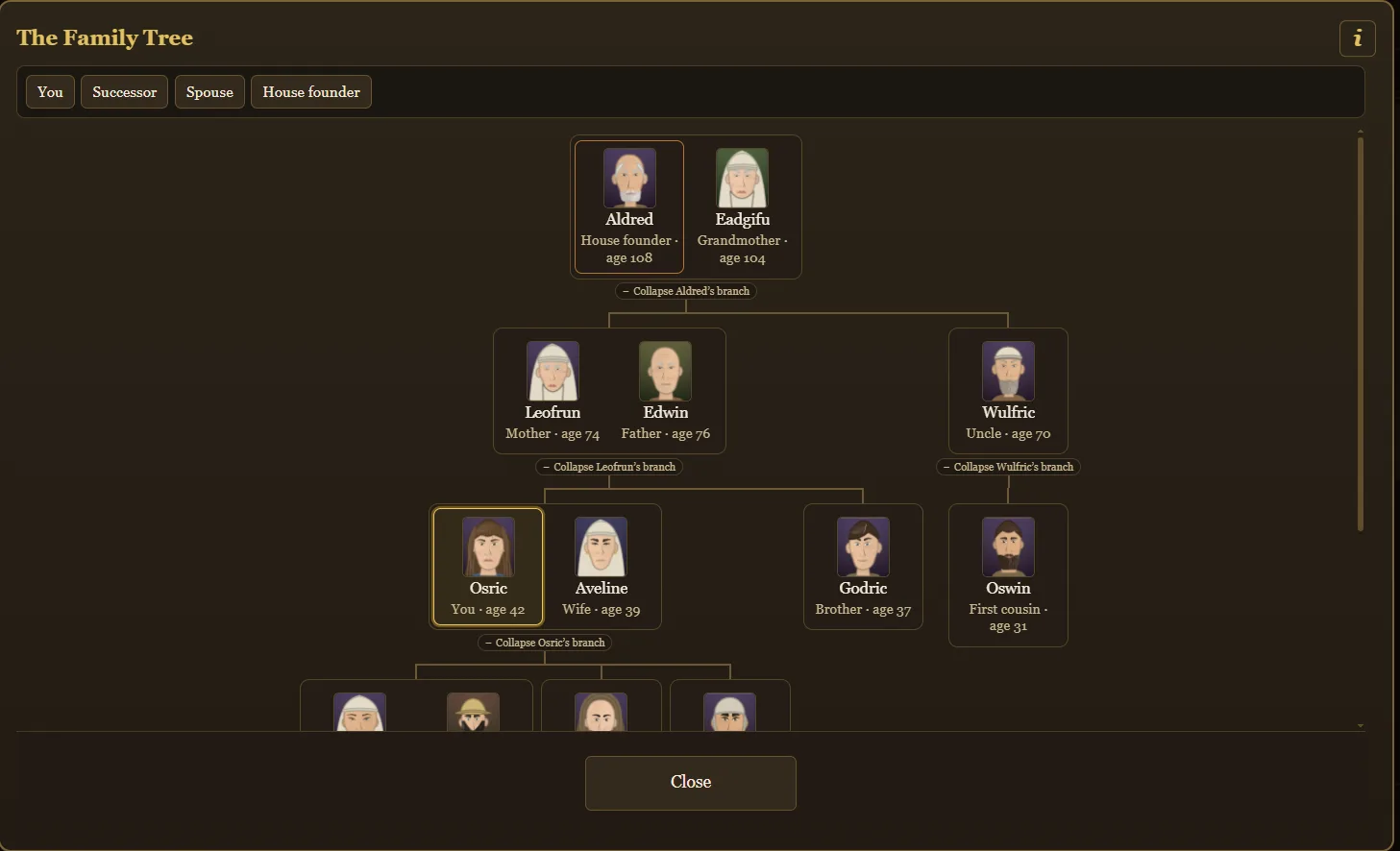
Desktop trees fill the available sheet, pan by dragging, and preview relatives on hover. Mobile trees center the current character and keep founder and successor markers visible. Character sheets return to the same tree position.
New campaigns now begin with the Serf start. Reaching Freeholder, Gentry, and Baron across successive lives permanently unlocks those starting roles in the browser. The first playable loop has clearer guidance for map navigation, work, deeds, courtship, marriage, and succession. Local marriage prospects now reflect the county's culture and faith communities.
Raid planning and saved war reports
The raid planner now keeps large target lists practical:
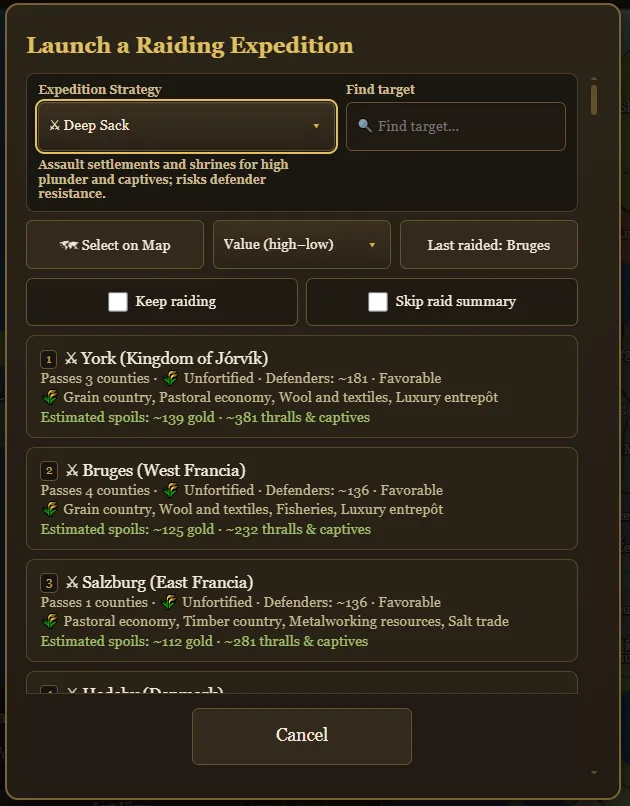
- Search and sorting: Filter targets by name, then sort by value, distance, or name.
- Repeat controls: Reuse the last reachable target, keep raiding after a result, or skip the summary sheet.
- Clearer estimates: Each target shows route length, fortifications, defenders, risk, local goods, and expected spoils.
Raid, battle, and war Chronicle entries now reopen compact saved result reports:
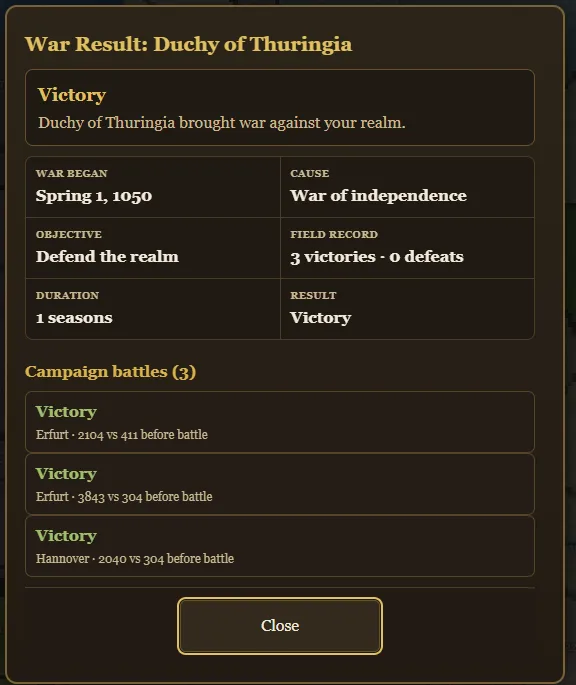
War reports preserve the cause, objective, duration, result, field record, and individual battles. Battle reports retain force sizes and unit-class losses. Wartime map orders now show enemy movement, and hostile hosts resolve field battles only when they occupy the same county.
Other changes
- Save files: Save Game now downloads a text file, and Load Game accepts downloaded files while retaining pasted-save support.
- Manual command: Entrusted field hosts now keep player-issued halt and march orders instead of reverting to AI control.
- Interface: Dense Governance, Council, Papacy, conquest, Network, and privilege sheets use more consistent controls, tooltips, and navigation.
- Performance: Panel switching and fast-forward retain unchanged interface and simulation state to reduce repeated work.
- Preview languages: French, German, Italian, and Spanish catalogs have been refreshed, while missing new records safely fall back to English.
Fallowborn is a free browser grand strategy game by one developer, built openly with AI assistance. Source on GitHub.