v1.133: Markets, local government, and fortifications
August 15, 2026 · Fallowborn devlog
Versions 1.125.0 through 1.133.0 add county commodity markets, local offices, configurable land grants, guild specialties and auctions, strategic fortifications, county communities, and portrait customization.
County markets connect prices, production, and trade
Every county now tracks five broad goods: provisions, wares, materials, transport, and luxuries. The Market lens colors counties by the selected good and marks prices as cheap, steady, or dear.
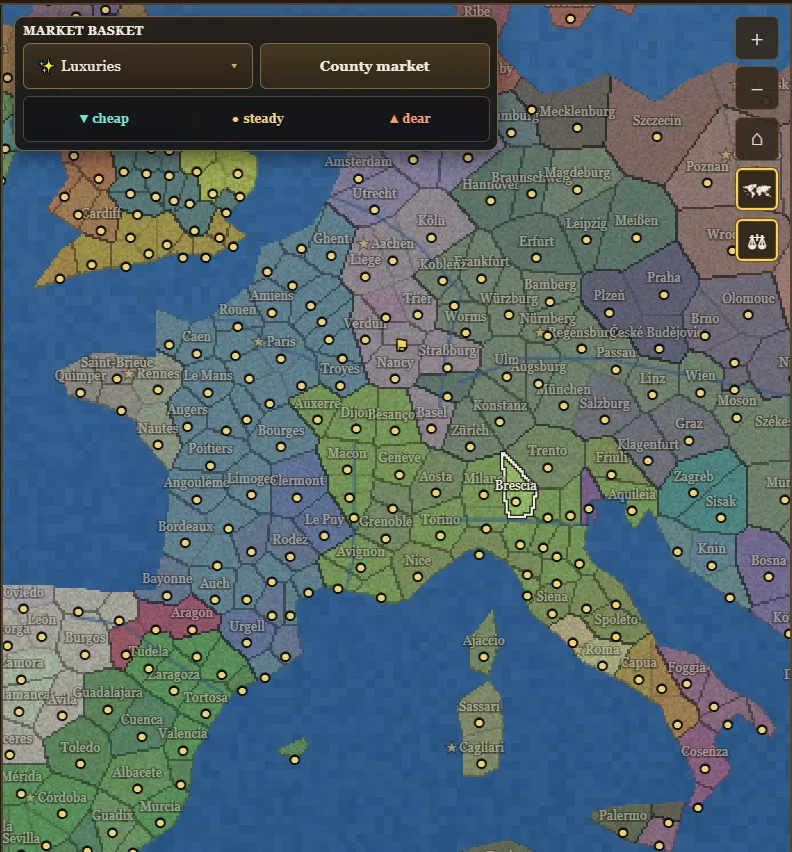
Markets update once each season. Terrain, development, buildings, enterprises, armies, and temporary shocks affect local supply and demand. Goods also move between neighboring counties, including across straits where local trade allows it.
Historical endowments give regions persistent strengths. Grain country produces more provisions, wool and textile centers produce more wares, horse-breeding regions improve transport, and major ports can distribute luxuries without producing them locally. The county market sheet lists those endowments with current stock, price, production, demand, imports, and exports.
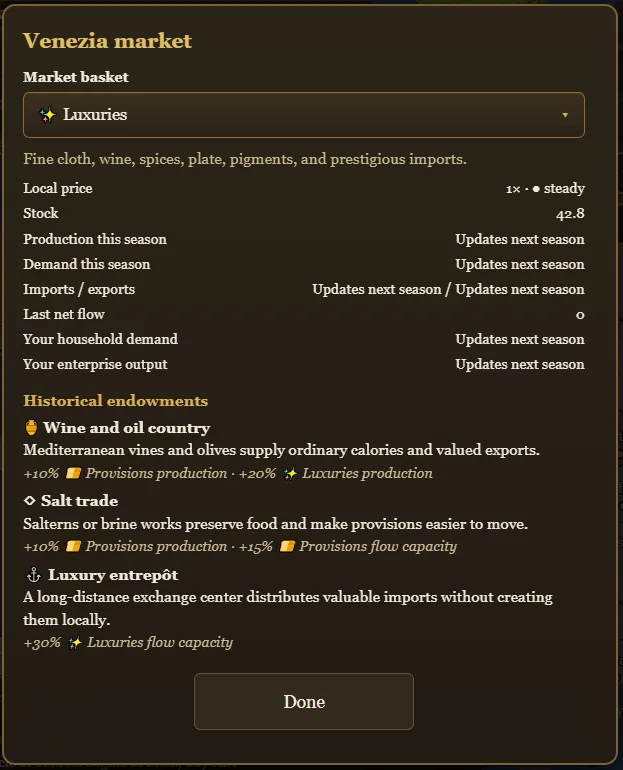
Local prices now affect tangible spending such as household necessities, equipment, enterprises, buildings, fortifications, and travel supplies. A household that cannot cover provisions can suffer persistent hardship. Trade ventures buy a chosen good at the origin and sell it at the destination's live price, while guild charters can support local production or an exact trade corridor.
Local offices have defined powers and terms
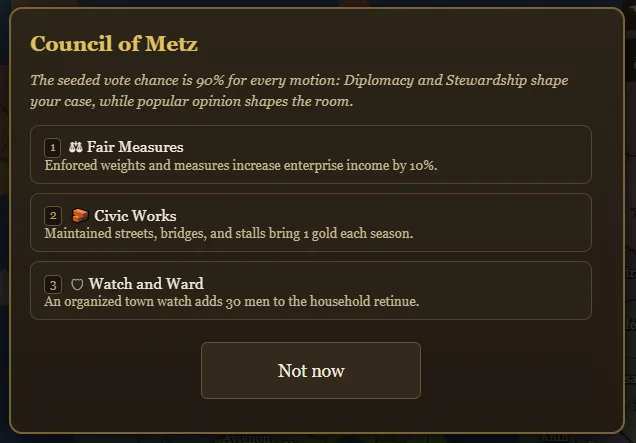
Town Councilman is now a local office tied to the household's home county. Once per year, the officeholder can propose Fair Measures, Civic Works, or Watch and Ward. A successful motion improves enterprise income, local revenue, or the household retinue for one year.
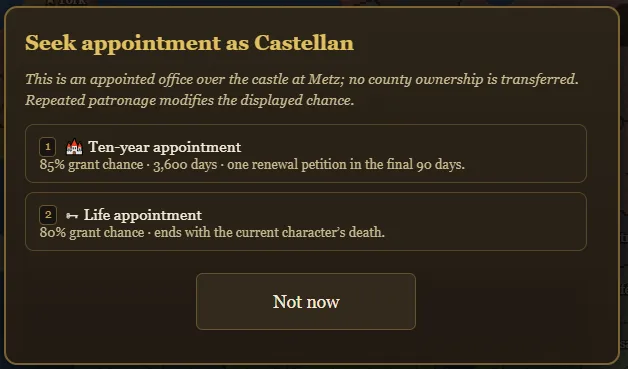
Landless gentry can also seek appointment as Castellan. This is an office over the local castle, not ownership of the county. The player can request a ten-year or life appointment, and a fixed term can be renewed once near expiry.
Land grants now specify the recipient and contract
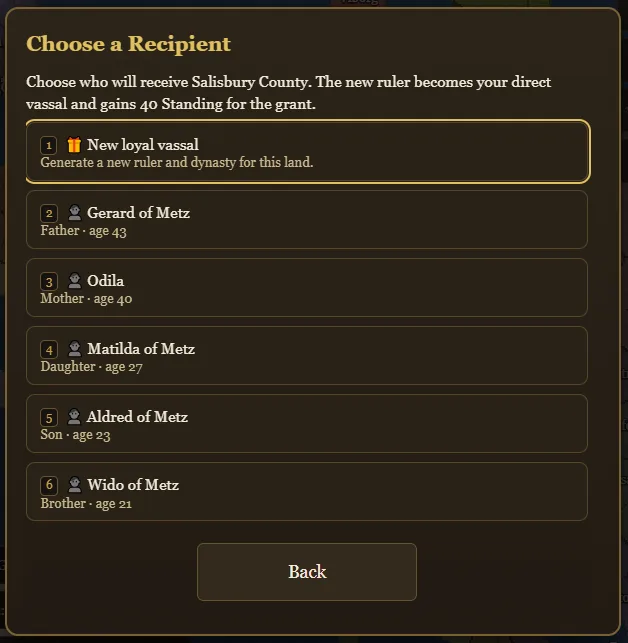
A ruler granting a county or duchy can install an eligible adult relative instead of generating a new vassal. The relative keeps their identity, family, and succession line, then leaves the household to govern the granted land.
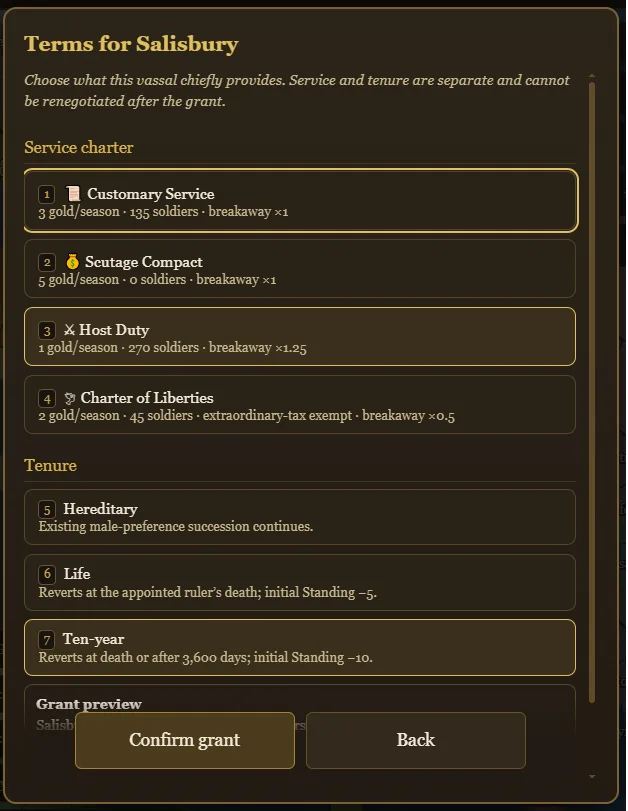
Each grant also combines a service charter with a separate tenure. Customary Service, Scutage Compact, Host Duty, and Charter of Liberties set different tax, levy, Standing, and breakaway terms. Tenure can be hereditary, for life, or for ten years. The preview shows the exact result before confirmation, and advanced terms list any missing technology.
Fortifications are strategic strongpoints
Fortifications are built at an exact settlement and progress through Ringwork, Towered Stronghold, Stone Castle, and Concentric Fortress. Each tier costs more to build and maintain, retains a larger garrison, and adds more local defense.
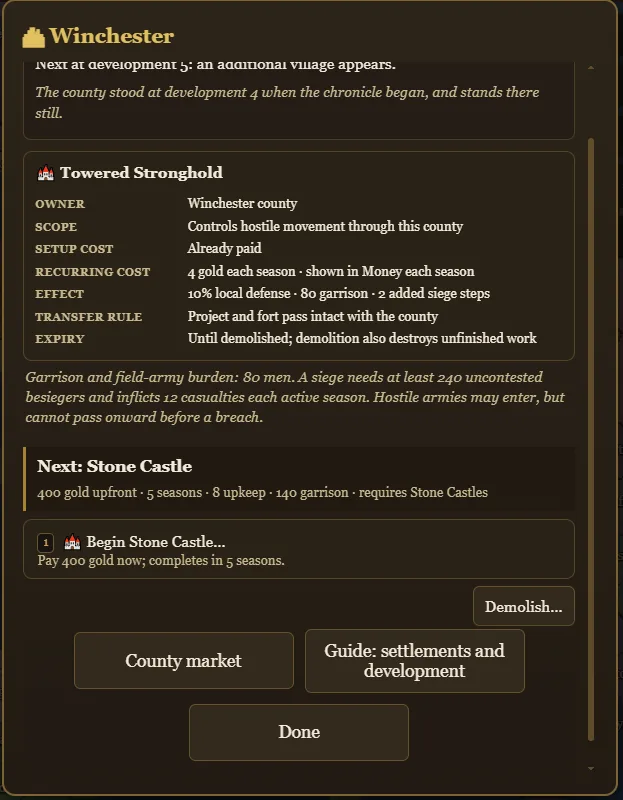
A hostile army can enter a fortified county but cannot continue through it until the fort is breached. Sieges need enough uncontested troops for the garrison, take additional seasonal steps, and inflict casualties on the besiegers. Armies can route around the strongpoint when another path exists. Forts and unfinished upgrades stay with the county after conquest or succession.
Guildmasters can specialize and households can bid
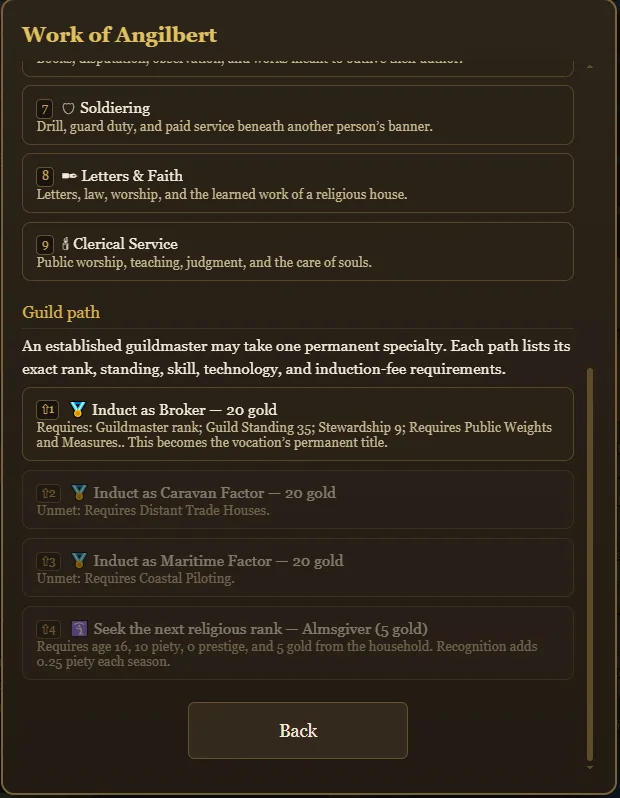
Craft and Trade guildmasters can now choose a permanent specialty. Smiths, Weavers, and Coopers improve matching work and enterprises. Brokers, Caravan Factors, and Maritime Factors improve different parts of trade. Advanced paths require the relevant national technology, while a baseline path remains available.
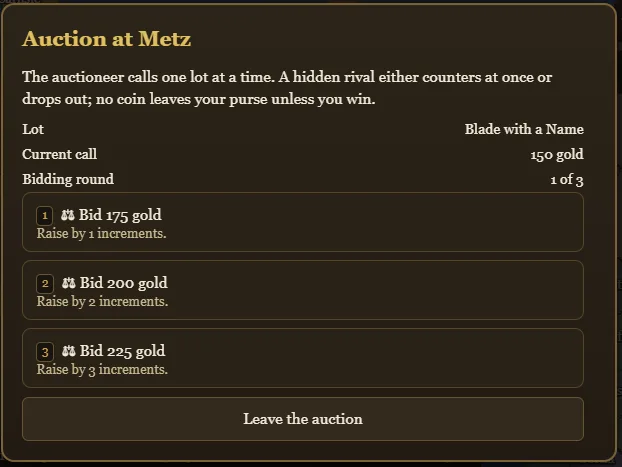
Households in a town or city can attend one market auction per year, with rare invitations providing another entry point to the same system. Lots can be notable items, enterprises at the auction site, or documented rights to a neighboring county. The player gets up to three bids, the rival has a fixed hidden limit, and only the winner pays.
County starts can include more than one community
Historically mixed counties can now list several local communities, each pairing a culture with a faith. Character creation lets the player choose one of those identities for the starting family, and shared start codes preserve a non-principal choice.
Communities are a starting identity, not a demographic simulation. They do not add population percentages, conversion, migration, or recurring processing. The county's principal culture and faith still govern the existing political systems.
Portraits can be customized at the barber
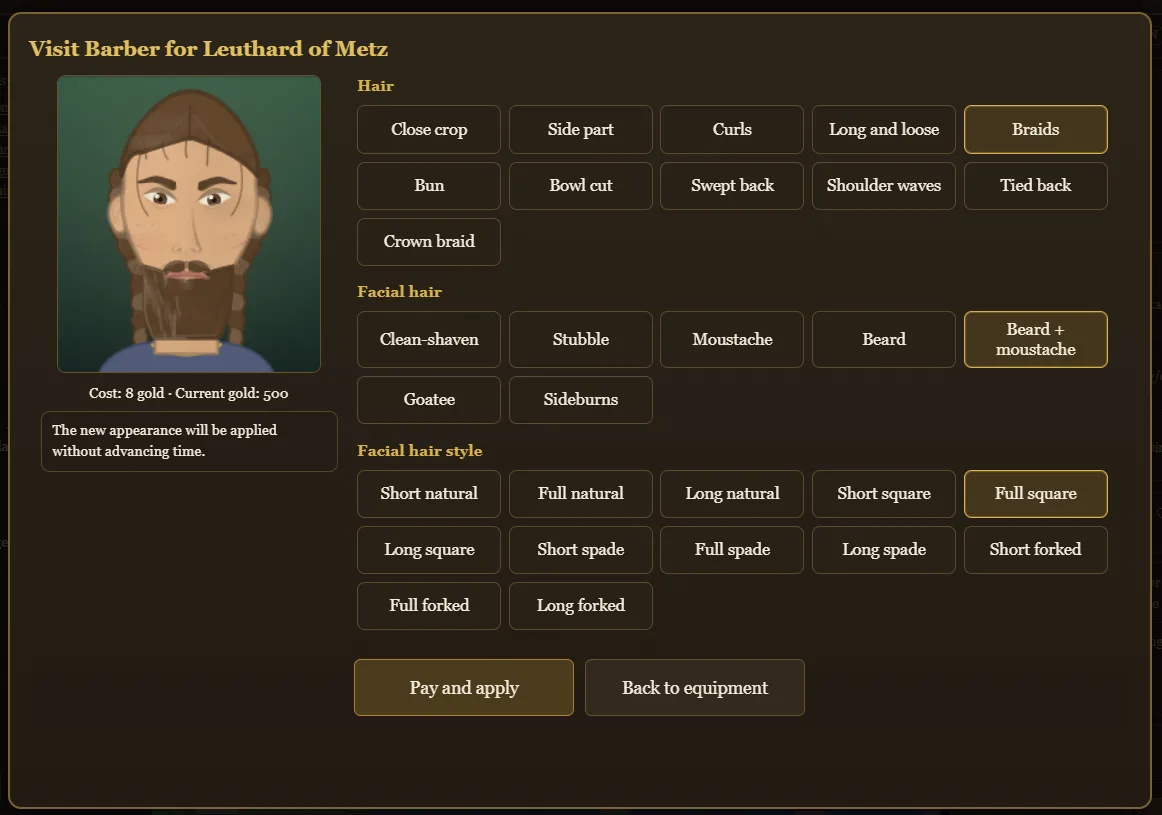
The protagonist's Equipment sheet now includes a barber. Players can choose a hairstyle and, for adult men, a facial-hair family and cut. The selection changes style without replacing the character's natural color or age-related greying.
Other changes
- Technology: Advanced guild paths, service charters, auctioned title rights, fortification tiers, and selected institutional or tournament choices now show their knowledge requirements while keeping ordinary alternatives available.
- Accessibility: Settings now provides separate color controls for main and helper text, with brighter defaults.
- Compact layouts: Market controls, side panels, the mobile map HUD, and the barber sheet stay usable on narrow or short screens.
- Royal marriages: Marriage offers from royal houses now respect the household's station and prestige.
Fallowborn is a free browser grand strategy game by one developer, built openly with AI assistance. Source on GitHub.