v1.124: Every place has a name, every choice has a cost
August 13, 2026 · Fallowborn devlog
Versions 1.116.2 through 1.124.1 bring towns, villages, and cities onto the close map, add a complete hostile-intrigue system, make event stakes visible before a choice, and give commoner and social life sharper boundaries and consequences.
Grand strategy often becomes more abstract as it grows. Counties become colors, people become modifiers, and choices become prose wrapped around a hidden roll. This release moves Fallowborn in the other direction. The closer you look, the more specific the world becomes.
A county now contains places you can see and visit. A scheme names its victim, method, and accomplice. A day of labor or a dangerous appeal tells you what is guaranteed, what might succeed, and what failure will cost. The map is broader than before, but it is also more local.
The map comes down to the settlement
Close zoom now reveals the inhabited world inside each county. Towns, villages, castles, abbeys, and other sites appear as shape-coded markers, then become procedural cottages, towers, and walled-city emblems as the map draws closer. Names sit beside the places themselves, while county seats and sovereign capitals remain visually distinct.
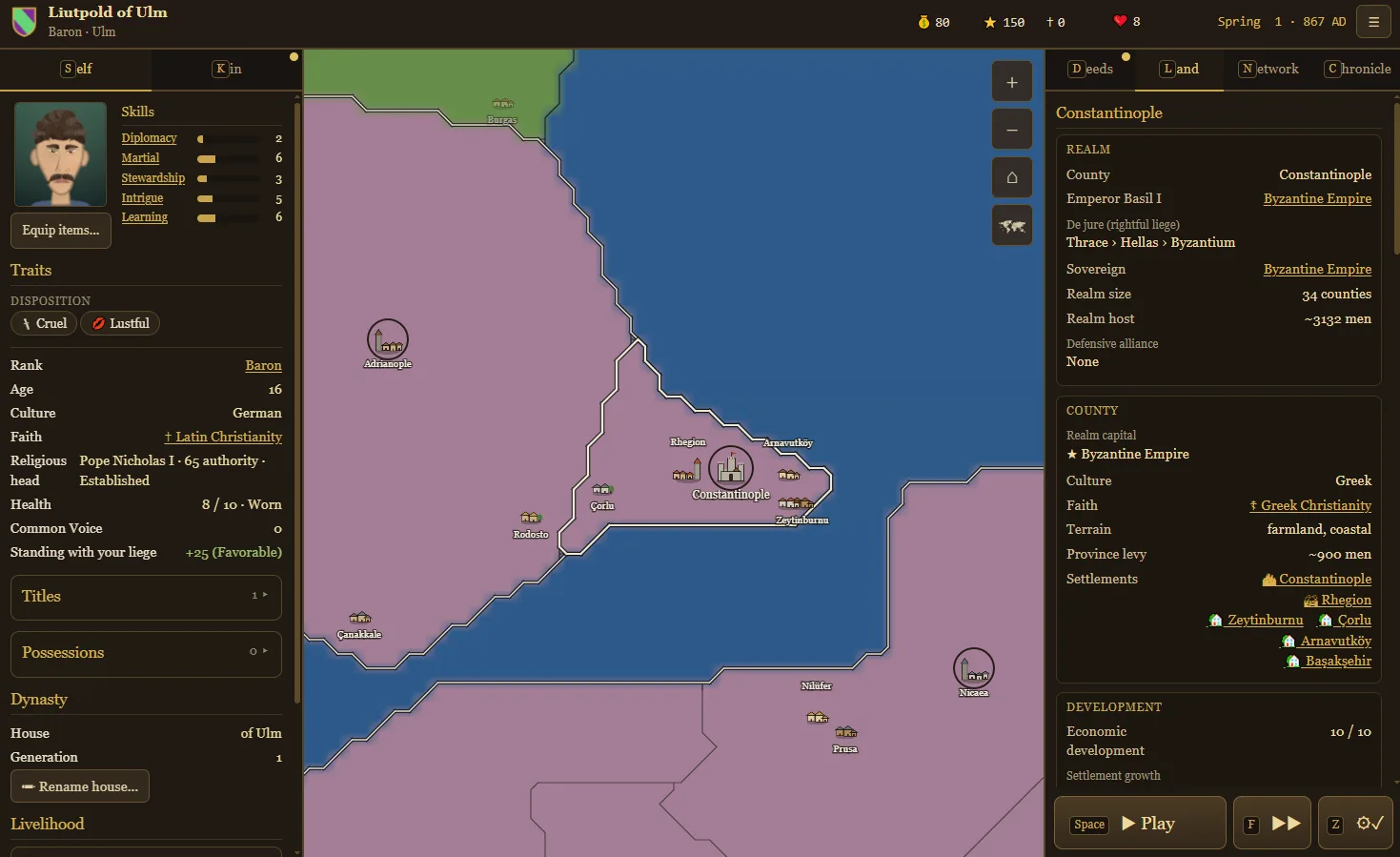
Around 140 major historical sites are placed by hand across the 867 and 1066 starts. Nearly three thousand additional real place names and locations fill the rest of the settled map. Modern-only names and district labels have been replaced or excluded where a better medieval identity is known, so places such as Jaffa, Königsberg, and the cities of medieval Anatolia belong to the period rather than the present-day database that supplied their coordinates.
Development changes what is visible. A poor county begins with a small settlement pattern; stronger counties reveal more villages and promote their leading sites toward towns and cities. Those places are not decoration. Tapping one opens its settlement sheet with the local holder, buildings, ruins, household land, manor, and enterprises. Settlement links in the Land tab now center the map on the same county.
New characters can also choose an exact birthplace. After selecting a county, the map closes in and lets the player tap a town or village, or accept the county seat. Shared start codes remember that place. Coastal positioning, sea crossings, and several misplaced sites have been corrected at the same time, including Venice on its lagoon island and counties that previously stretched across straits.
Intrigue now has victims, methods, and evidence
Political plotting is no longer limited to broad court maneuvers. Assassination, abduction, blackmail, fabricated charges, and sabotage join the existing claim and council schemes. Each begins with an exact person, office, or county that remains attached to the plot through discovery and resolution.
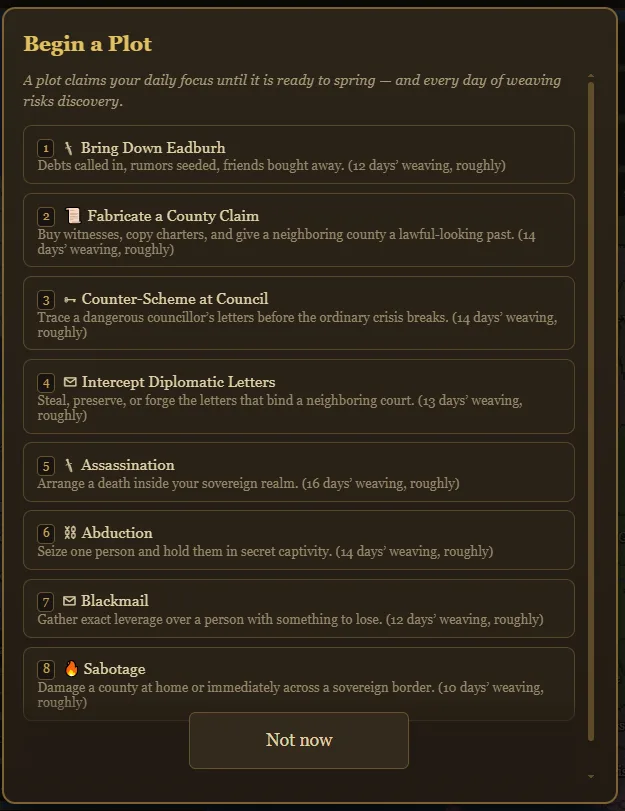
The player then chooses how to proceed. A careful method takes longer but attracts less attention. Bought access spends money for speed and opportunity. Force can move quickly while leaning on Martial and accepting greater exposure. An accomplice is optional: a willing insider can improve the scheme, a paid helper costs more, and a refusal may leak the attempt before it has properly begun.
Other rulers and courtiers use the same system. AI schemes are bounded to politically relevant targets, and murder or abduction aimed at the protagonist or a managed relative produces a warning event rather than resolving unseen. Investigation, security, a counter-trap, or deliberate inaction can change that exact threat.
Discovery is not the same as guilt. Suspicion can follow a scheme without creating lawful proof. Testimony, material evidence, or capture in the act can lead to a hearing before the proper authority, with the offense and available sentence preserved in the case. Successful abduction creates a real captive who may be ransomed, released, or exchanged for leverage. Blackmail creates durable leverage over one exact person. Intrigue now leaves people and institutions changed after the progress bar disappears.
The bottom rung bears real obligations
Serf life now carries a wider range of customary burdens. The lord's harvest can take priority over a household's own grain. Week-work can grow after a steward revises the tally. Mill dues, pannage, marriage leave, tithes, bridge cartage, oven tolls, forest rights, and the quartering of soldiers all ask the family to pay in coin, labor, health, reputation, or defiance.
These are not one universal law applied to every manor. Terrain, faith, season, war, marriage, and circumstance determine which stories belong in a life. Most are recurring pressures; extraordinary tallage and the seizure of seed grain are rarer crises.
A separate rare raid chain can reach an unlanded household, including during childhood. The attackers follow the region and faith around the protagonist, from Northmen and frontier troops to steppe or Rus raiders. Escape may preserve the family, cost a piece of its actual property, or fail into captivity. Submission strips local property and forces the household into the captor's settlement, while one last escape attempt can end in freedom or death.
Every choice shows its stakes
Events now separate authored story text from a mechanical preview. Hovering a choice on desktop opens a side tooltip. Touch screens and compact layouts use a question-mark disclosure instead. Guaranteed consequences, possible success, and possible failure receive their own sections, and chance is described in readable bands such as Even or Risky rather than exposing the random roll.
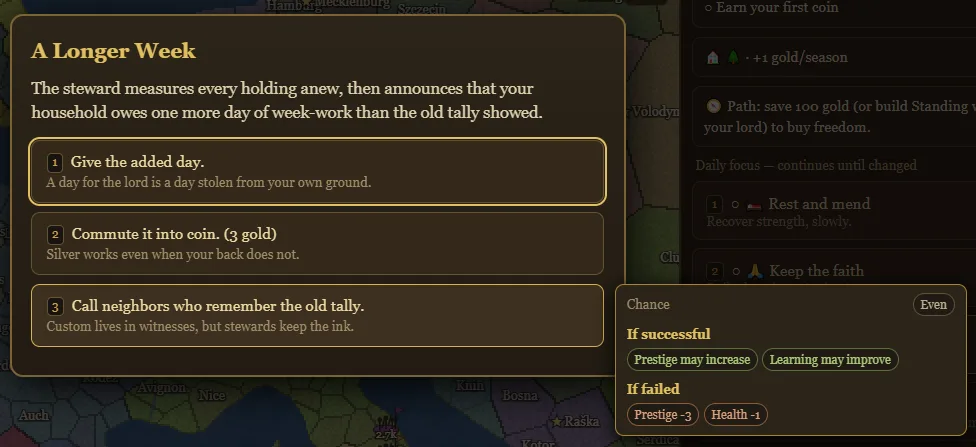
Costs, penalties, property loss, durations, and lethal risks are exact. Favorable rewards remain qualitative until earned, so the preview explains the stakes without turning an uncertain story into a solved equation. After the choice resolves, one result notice reports what actually happened.
The Chronicle keeps the same receipt. Its new filters can show all entries, only choices, or only wider news, and each choice records the event, the answer, the outcome, and the final mechanical effects. Autoresolve uses the same resolver, so an automated choice and a manual choice no longer pass through separate rules.
Rank shapes who will answer
Social reach now follows station. A serf cannot approach a royal court as casually as a duke, but a genuine relationship can bridge the gap. Warm contacts act as intermediaries into higher circles, while distant or socially remote contacts make cultivation, gifts, courtship, and bought intrigue less effective and more expensive.
The road upward has gained one exceptional military path. A battle-proven founder of a new gentle house, with enough Martial ability and prestige, may command a count-or-greater patron's contingent during a real war. One field victory can earn the first barony in that founder's own life. The ordinary route still asks a later generation of the established house to petition, and a sibling inheriting at the same generational depth no longer counts as that next generation.
Marriage searches can now sound out a new set of families every thirty days for the protagonist and eligible descendants. Prospect ages follow the person being matched, with a broader young-adult option for protagonists aged forty or older.
Interface, balance, and reliability notes
- Living crowns: An AI king keeps the crown while holding land inside its kingdom, then falls to the ruler's true landed rank once driven out.
- Local households: Local lords retain their own households through friendship and marriage and cannot be hired into the player's household service.
- Long campaigns: Daily simulation, army routing, autosaves, and Chronicle refreshes do less repeated work in long-running lives.
- Music: Christian, Muslim, and pagan title themes now rotate on the title screen, can continue through Android screen locks when enabled, and switch cleanly into the gameplay soundtrack. The title controls now include pause and next.
- Guidance: Every Guide topic links to its exact documentation section, and optional guide hints can be disabled in Settings.
- Hosted updates: play.fallowborn.com can announce a newly deployed version and save before reloading without interrupting the current session.
- Map and interface polish: Realm colors and outlines are configurable, result notices remain anchored clear of controls, and music, event, and tutorial notices no longer compete for the same corner of the map.
Fallowborn is a free browser grand strategy game by one developer, built openly with AI assistance. Source on GitHub.