v1.113: Faiths fracture and every court has an agenda
August 7, 2026 · Fallowborn devlog
Versions 1.110.2 through 1.113.3 let faiths branch during play, give rulers and relatives ambitions of their own, and make political office answer to elections, constituencies, and durable privileges.
Fallowborn's map has always kept moving, but much of the meaning behind it began as a fixed definition. A ruler had a temperament without a long-term purpose. A faith had doctrine without a history that could continue inside the campaign. A guild promotion or political concession could change a number without leaving behind the institution that made it happen.
This release gives those systems memory and direction. New faiths descend from old ones and remember how the split began. Rulers pursue aims, form opinions, and approach the player's family when distance and politics make that contact plausible. Relatives choose goals of their own. Elections reveal who has a vote, what they expect, and how a candidate intends to win it. Written privileges remain in the political record after the audience ends.
Faith becomes a family tree
Faiths now form an inheritance graph rather than a collection of isolated labels. A branch can inherit marriage rules, religious vocabulary, offices, and other doctrine from a parent while replacing only the parts that distinguish it. Broad traditions such as Christianity and Islam can supply common roots without appearing as a character's playable faith.
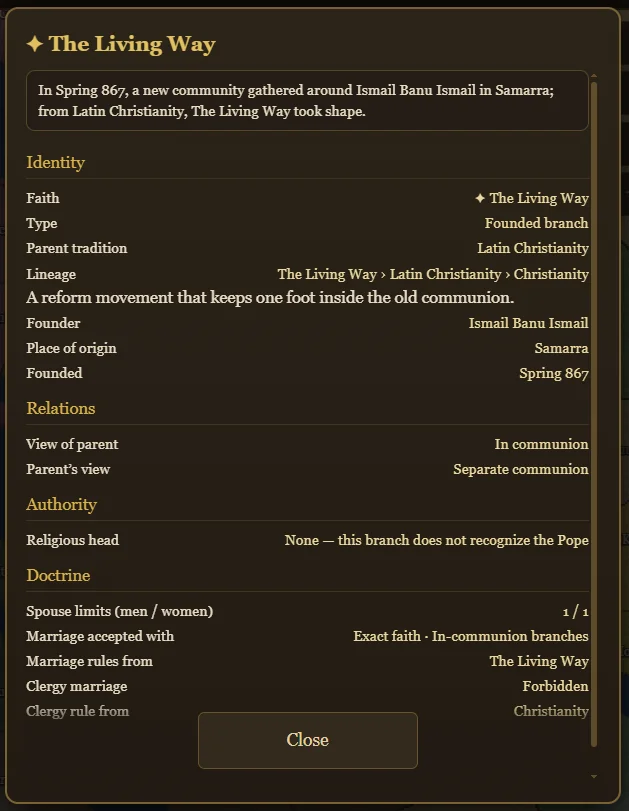
New branches can be founded during a campaign through the same data-driven system used by authored faiths. A founding records the reform's name, founder, place, date, parent tradition, and new relationship to the old communion. It can convert the founder, household, and player realm, and it remains part of the save rather than disappearing when the event closes.
Relationships between faiths now have direction. A reform may still see itself inside the parent communion while the old hierarchy considers it schismatic. Exact, related, foreign, and explicitly hostile faiths provide different starting points for Standing and ruler regard, then culture, allegiance, gifts, grievances, and war continue to move those relationships. Marriage rules and religious wars consult the same family tree.
The Faith sheet makes that history readable. A campaign-founded branch receives an origin account, a complete lineage, both sides of its relationship with the parent, its marriage and clergy rules, and the ancestor that supplies each inherited doctrine. A new branch does not quietly inherit a Pope or Caliph unless its definition explicitly keeps that authority.
The graph is open to events and mods. A new sect no longer needs a new engine category or a copy of every ancestral rule, and validation catches missing parents, cycles, malformed doctrine, and invalid religious offices before those definitions enter play.
Every ruler wants something
Each living AI ruler now pursues one durable aim shaped by personality and political position: secure the dynasty, expand, accumulate wealth, defend the faith, strengthen the crown, seek independence, or preserve peace. Succession gives the new ruler a new aim instead of inheriting the predecessor's private purpose.
Those rulers also maintain a bounded political world around the player. Lieges and vassals, neighboring sovereigns, and relevant peer houses can warm or cool toward one another based on culture, faith, alliances, war, and annual political contact. The simulation stays focused on courts that can matter to the current family rather than creating an invisible relationship record for every possible pair on the map.
Relevant courts can now act on those aims. A ruler may send a friendly overture, propose a royal match for a managed family member, or secretly support a discontented vassal across the border. Distance, culture, faith, existing commitments, and a per-ruler cooldown keep these approaches connected to the player's actual political neighborhood. Foreign support discovered inside your realm can be exposed, bought off, or watched for advantage.
Relatives find their own place in the story
Managed family members now choose ambitions suited to their age, abilities, and circumstances. A relative might seek a place in family service, pursue a livelihood, deepen a skill, or work toward another personal milestone. These goals belong to the character rather than becoming another household automation setting.
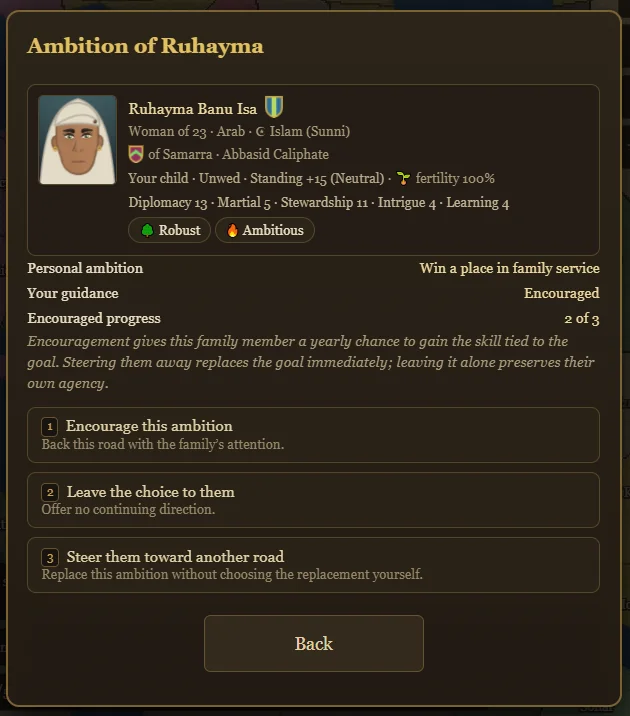
The player can encourage an ambition, leave it alone, or steer the relative toward another road. Encouragement gives a yearly chance to grow the skill behind the goal, and sustained progress earns a small family milestone. Steering someone away changes the goal without letting the player choose an exact replacement, preserving a boundary between guidance and control.
Adult relatives can also hold the same practical household offices previously reserved for hired retainers. A qualified family member may serve as steward, factor, captain, or tutor, provide the listed benefit, and occupy the real shared office slot without wages or retainer capacity. Marriage and residence still matter, so the arrangement ends cleanly when the relative leaves the managed household.
Office is won in public
Guild advancement beyond Master is now political. Officer and guildmaster positions require eligibility, a vacancy, nomination, a public campaign, and a recorded vote. Each election names its weighted constituencies and rival candidates, then shows expected support before the player commits to a tactic.
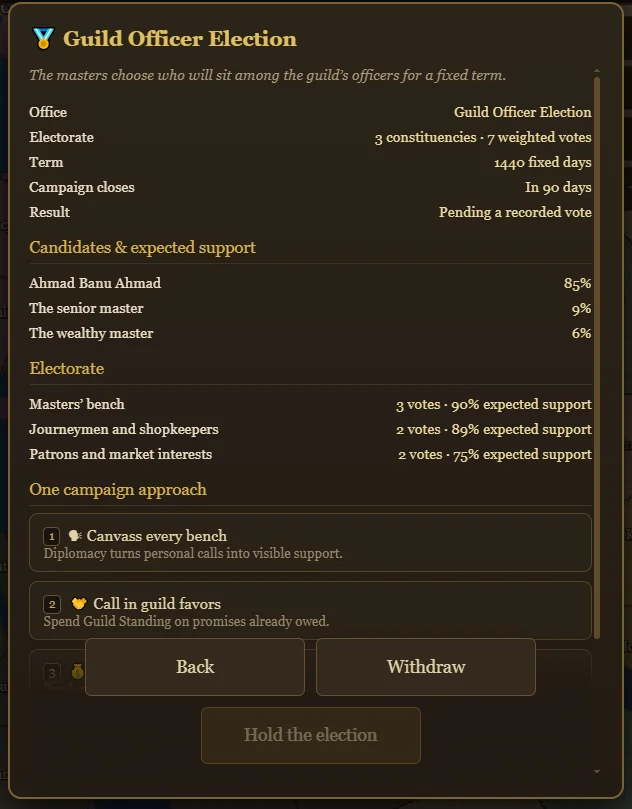
Canvassing leans on Diplomacy, favors spend Guild Standing, a funded campaign buys hospitality and notices, and standing on reputation trusts the candidate's existing record. Victory creates a fixed territorial term. Defeat seats the rival and imposes a candidacy cooldown rather than quietly allowing another roll the next day.
The same election framework reaches the royal council when the Charter of Liberties requires confirmation of great offices. A king or emperor nominates a direct vassal for Treasurer or Constable, the relevant constituencies weigh the candidate, and a confirmed officer receives a protected term that the crown cannot simply dismiss.
Political concessions now leave a durable privilege roll. Market charters, confirmed custom, levy exemptions, sanctuary, tax concessions, consent of the Estates, and confirmation of great offices record their holder, grantor, territory, rights, obligations, duration, and lawful route of revocation. Commons, guilds, faith communities, and magnates can organize around these protections and present collective demands. The ruler can grant the demand, negotiate, or refuse and give the opposition a common cause.
One forbidden road has rules and consequences
Ordinary close-kin marriage remains prohibited, and AI rulers, arranged matches, and household assistants will never choose it. The sole exception is an explicit player approach to an adult full or half sibling when both people are free to marry, together in one place, already close, and personally inclined toward crossing that boundary.
Acceptance is not automatic. Traits and Standing shape a separate response, refusal can close the road permanently, and an irregular courtship risks discovery each season. A faith with an explicit sibling rite can recognize the marriage. Every other route carries losses to piety, prestige, Common Voice, and political Standing, marks both spouses with a lasting scandal, and gives children an elevated health risk. The system treats the choice as an exceptional dynastic transgression, not a loophole in ordinary matchmaking.
Interface, balance, and reliability notes
- Debt defaults: Coin and Credit now shows the route from default to distraint, keeps full settlement available during default, and gives each station an appropriate final consequence, from forfeited property to bondage or labor service.
- Role-aware controls: Technology and realm automation stay hidden from roles that cannot use them, while locked household choices name the national prerequisite that would open them.
- Rome: Rome is reserved for the Pope and can no longer be granted as a personal Bishopric.
- Faith and Standing: Exact and related faiths begin warmer, foreign faiths begin guarded, and explicitly hostile faiths begin sharply opposed. These are starting relationships, not permanent verdicts.
- Dialog and keyboard behavior: Recent election, privilege, debt, family, faith, and exceptional-courtship sheets now use consistent exits and safer confirmation focus. Submitting a shared start code with Enter no longer reopens New Game over character creation.
- Hosted play analytics: The hosted build now distinguishes campaign starts, returns, active play, succession, and completed sagas without sending character names, seeds, or save contents.
Fallowborn is a free browser grand strategy game by one developer, built openly with AI assistance. Source on GitHub.