v1.110: The ladder goes both ways
August 4, 2026 · Fallowborn devlog
Versions 1.106.0 through 1.110.1 make rank something that can be lost as well as won, teach a new dynasty through play, let management tools respect the player's reservations, and turn literacy into three complete professional paths.
Fallowborn begins with a climb. A family works out of serfdom, becomes established, acquires land, gathers titles, and tries to make each generation stronger than the one before it. But a world in which every gain is permanent eventually stops feeling historical. A crown without a kingdom beneath it is only a costume, and a family that cannot pay its debts should fear more than a red number.
This release gives the ladder a downward direction without making every setback an ending. It also makes the climb easier to understand and a mature household easier to steer. New players receive lessons in the moments when they matter. Experienced players can protect the choices that automation should leave alone. Lettered characters can build lives in administration, medicine, and scholarship rather than treating literacy as a passive bonus.
The ladder goes both ways
A ruler can now survive defeat by surrendering power. When a greater and much stronger enemy has nearly won a defensive war, the victor may offer terms: bend the knee and keep every acre beneath a new liege, buy peace with heavy tribute, or continue the war and risk losing the land itself.
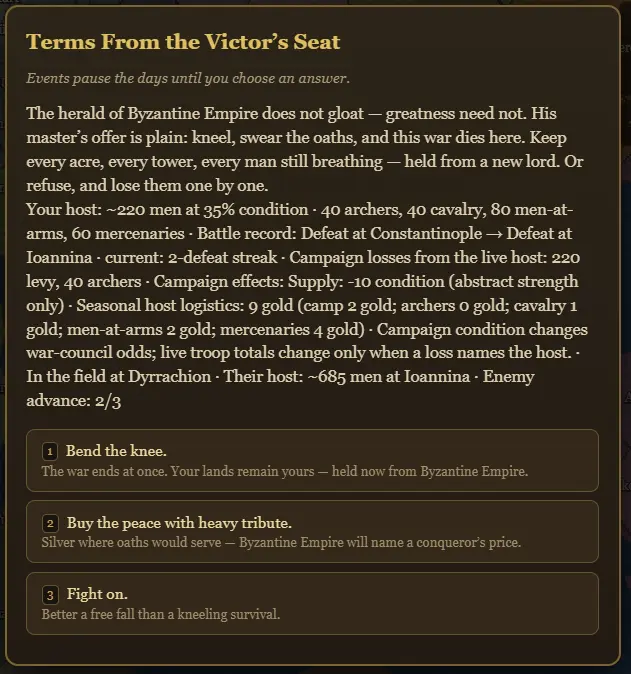
The offer does not appear in a vacuum. The war summary carries the host still in the field, its two defeats and named losses, the enemy massed at the frontier, and the seasonal cost of keeping the remnants together. Submission reads as the end of a campaign the player actually fought.
Submission is one part of a wider descent system. Ducal, royal, and imperial titles now need the territory and independence that justified them. If that substance disappears, the family receives a warning and time to recover before the title lapses one rung. A crowned ruler who swears fealty keeps a life and a domain, but cannot indefinitely pretend to be sovereign.
War has other costs. A beaten landed ruler can be taken in the rout and held for ransom. The household may pay in silver, sign over a border county, or wait in captivity while the campaign continues without its leader. A vassal who repeatedly defies a liege can face attainder, then yield the fief or raise a banner in resistance.
The lower stations have their own paths downward. A loan left in default can bring a writ of distraint, the seizure of holdings and land, and finally debt bondage. Raiders burning a common family's home can destroy property; after repeated devastation, a freeholder may trade freedom for a lord's protection.
None of these falls arrives as a bare random demotion. They grow from lost territory, military defeat, defiance, debt, or an occupied home. Warnings and choices give the family a chance to pay, plead, resist, surrender, or flee. Previous rank remains part of the house's record, and restoration is still possible. A fall is a new chapter in the dynasty rather than the deletion of everything it achieved.
A new life learns by living
New campaigns now open with a staged tutorial in the Deeds tab. First Steps teaches the daily loop: choose a focus, let time move, complete a deed, answer an event, and earn the first new coin. Lower-station families then move into Making a Living, followed by Family and Legacy.
The checklist is joined by three short story chapters, beginning with a neighbor arriving with bread and advice. The later chapters mark the first livelihood and the beginning of a family legacy. Small nudges appear on the Deeds and Kin tabs, resource breakdowns explain what each currency does, and the first visits to Land, Network, and Kin receive short introductions with links into the Guide.
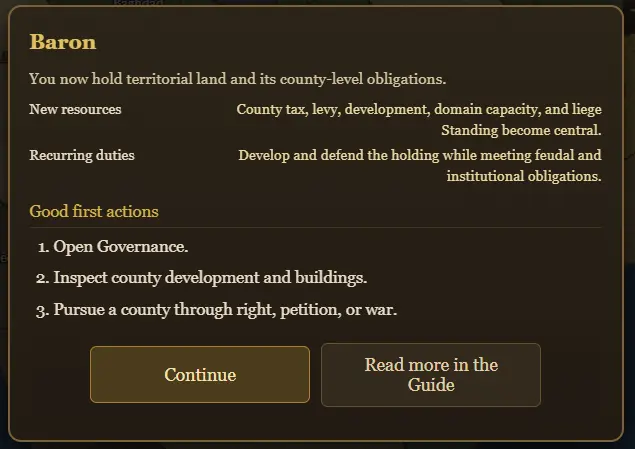
Rank and vocation changes now use the same principle. Becoming a baron, ruler, guild member, or religious officeholder opens a focused briefing that names the new resources, recurring duties, and a few good first actions. It no longer opens the full Guide and asks the player to find the relevant rule inside it.
The guidance is per save, disappears when complete, and respects Hide beginner hints. Old campaigns are not forced through a tutorial written for a new life. The Deeds tab also hides systems that a station cannot currently use, so a serf no longer begins with empty financial and commitment ledgers competing with the actions that matter.
Automation can be told no
Automation is useful only when it respects intent. A player who carefully kept one county, trained one child, paired one worker, or preserved one heirloom should not have to fear that a broad assistant will quietly undo the decision.
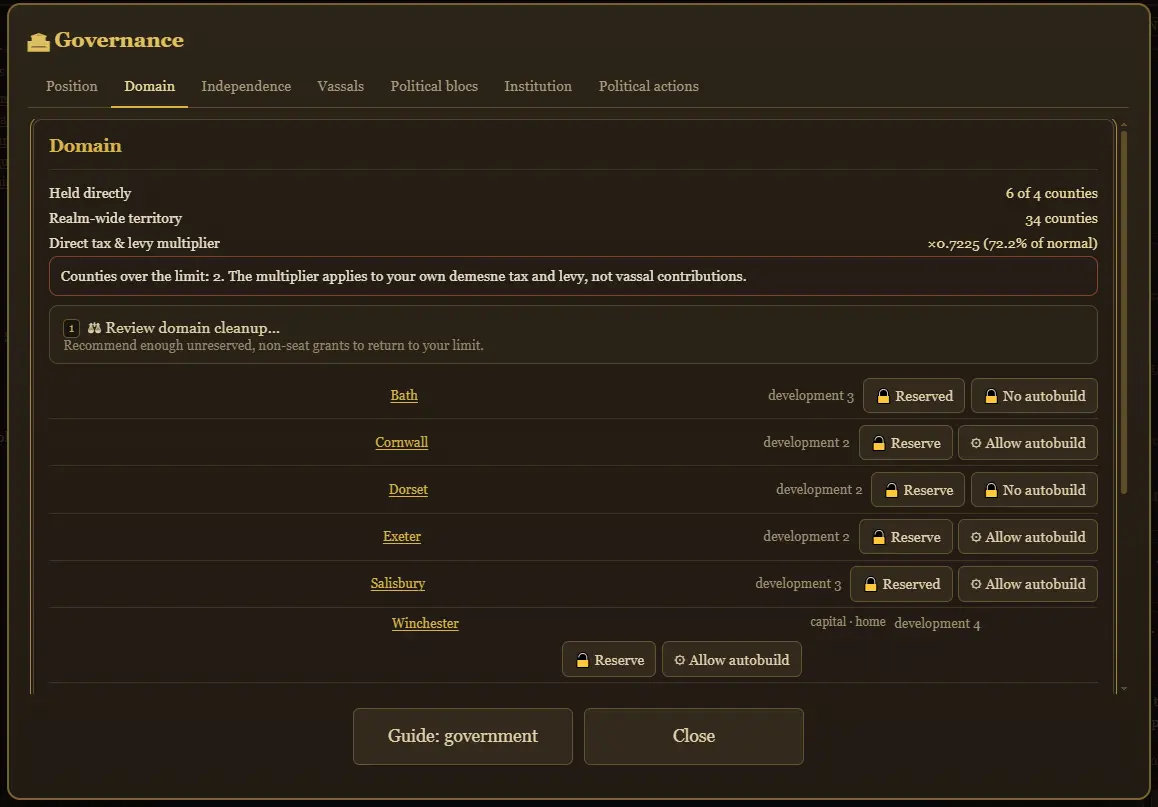
The new protection system puts those boundaries beside the things they affect. A county can be reserved from grants or automatic construction. A person can be left out of automatic staffing, education policy, or match recommendations. Items can keep their assignments through Equip Best and succession. Technologies can be excluded from automatic research, and vassals can be withheld from automatic Council appointments.
These protections constrain assistants rather than the player. Manual actions remain available, and removing a reservation restores the ordinary choice. The controls use the same language everywhere, making it clear whether the family has protected a person, place, object, or project.
Governance now also offers a review-first Domain Cleanup when the ruler holds too many counties directly. The proposal keeps the capital and household home, skips reserved land, prefers complete duchies where possible, and shows the counties, tax, and levy consequences before anything changes. If the realm changes while the review is open, the proposal must be reviewed again.
Nested management screens now return to the place they came from after an action. Building several works, changing household jobs, assigning enterprises, reviewing matches, or managing Governance no longer means repeatedly reopening the same chain of dialogs.
Letters become a profession
Reading and writing now open three scarce learned careers: Administration, Medicine, and Scholarship. Each begins with training, grants Lettered through practice if the character did not already have it, and leads to a paid professional examination with visible age, experience, skill, technology, fee, and success requirements.
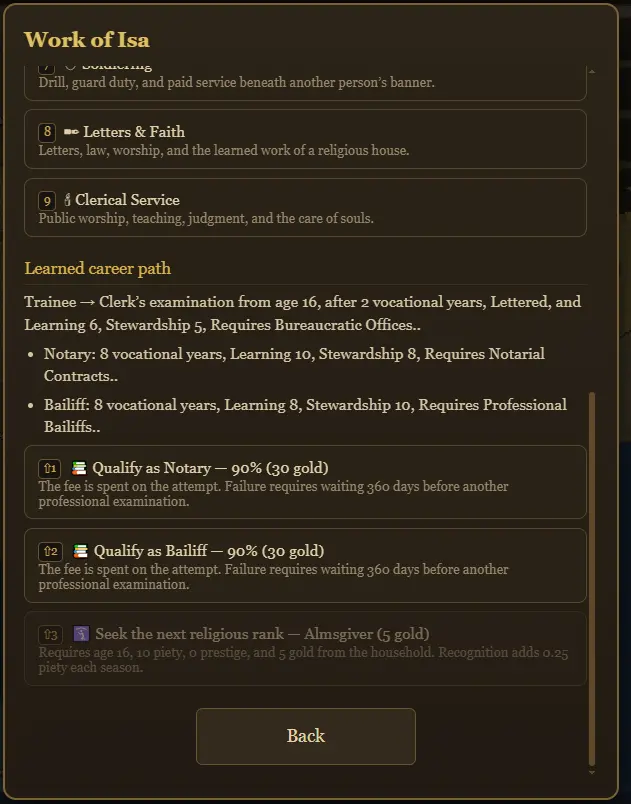
A licensed Clerk can qualify as a Notary or Bailiff. A medical Practitioner can become a Physician or Apothecary. A Scholar can become an Author or Astronomer. Each branch asks for years in the vocation and its own combination of Learning, Stewardship, and national knowledge. Examination chance rises with skill, failure imposes a cooldown, and changing work preserves the old career record for a possible return.
The branches produce different rewards. Administrators earn through records and law, with Bailiffs building Standing with the relevant authority. Medical practitioners protect the resident household from mortality, with each specialization changing that protection. Scholars add national research; Authors also produce a quality-rolled book that remains in the family armory, while Astronomers contribute more research.
Literacy now matters in advanced Trade as well. Guild leadership beyond Master requires Lettered and sufficient Learning, turning written accounts and correspondence into part of the merchant's actual career rather than flavor around it.
Interface, balance, and reliability notes
- Title grants: A liege's grant now stays inside that liege's realm, never takes the liege's seat or last county, and only a king or emperor can make a duke. A duke's vassal who gathers the required lands holds the claim until answering to a crown or becoming independent.
- Station-aware Deeds: Serfs no longer see Coin and Credit unless the family has a debt or pawnable property, the ongoing-commitments ledger stays hidden when empty, and Technology appears only after reaching landed rank.
- Protected domains: Governance vassal rows are more compact, and automatic construction now handles a domain in which every county is reserved without failing or choosing protected land.
- Learned work fixes: Medical practitioners now provide the intended household mortality protection, and Bailiffs gain Standing with the local authority even when the family has no direct liege.
Fallowborn is a free browser grand strategy game by one developer, built openly with AI assistance. Source on GitHub.