v1.105: Faces, lances, and laws
August 2, 2026 · Fallowborn devlog
Versions 1.97.0 through 1.105.2 redraw every character, open the tournament lists, give the Estates a real legislative agenda, and make the rules and consequences of war much easier to read.
Fallowborn asks one family to survive centuries of changing work, rank, marriage, politics, and war. As those systems grew, two things had started to lag behind them. The people carrying that history still appeared as very simple figures, and some of the most important decisions were hidden behind lists or rules the player had to learn by failure.
This release works on both problems. The court now looks like a cast of people rather than a row of symbols. Political choices show who supports them and why. War declarations name the right being asserted, or admit when there is no right at all. The Guide, household tools, and campaign records put more of the simulation where it can be acted on.
The court steps into the light
Every character portrait has been rebuilt in the procedural Court Illustration style. The new renderer gives faces stronger structure, distinct hair and beards, culture-aware dress, rank and faith headwear, expressions, age, sickness, and lasting marks from the life behind them.
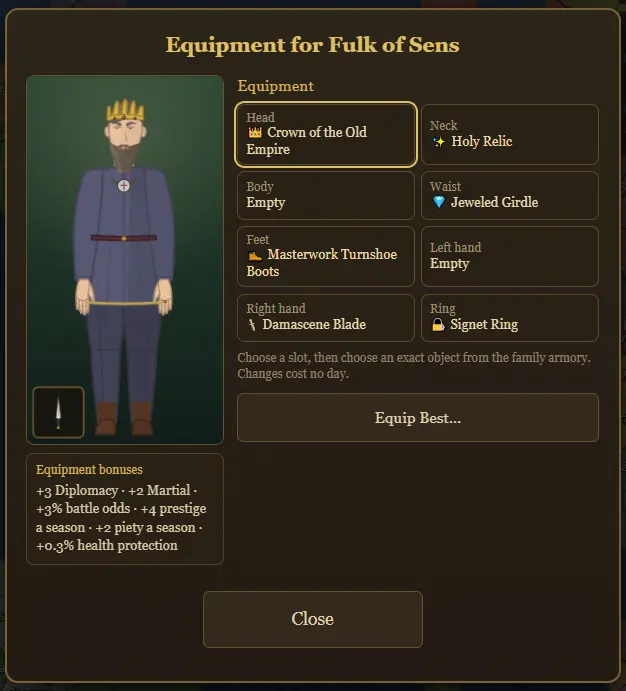
The result is still generated entirely inside the browser. There are no imported portraits or external image assets. A character's visual identity is derived from the same stable record as before, so a wound, illness, new office, or inherited crown changes the parts that should change without turning the person into somebody else.
Equipment now has a body to sit on. The family armory screen stages a full standing figure, puts worn clothes, armor, crowns, and footwear in their proper places, and gives hand weapons their own side panels so they remain readable. Portraits also render at the screen's full pixel density, keeping faces and figures sharp on phones and high-DPI displays.
The Estates have an agenda
Redress and scutage were the beginning of Estates politics, not the end. The assembly now has a data-driven catalog of nine policies across aid, military service, commerce, custom, and war.
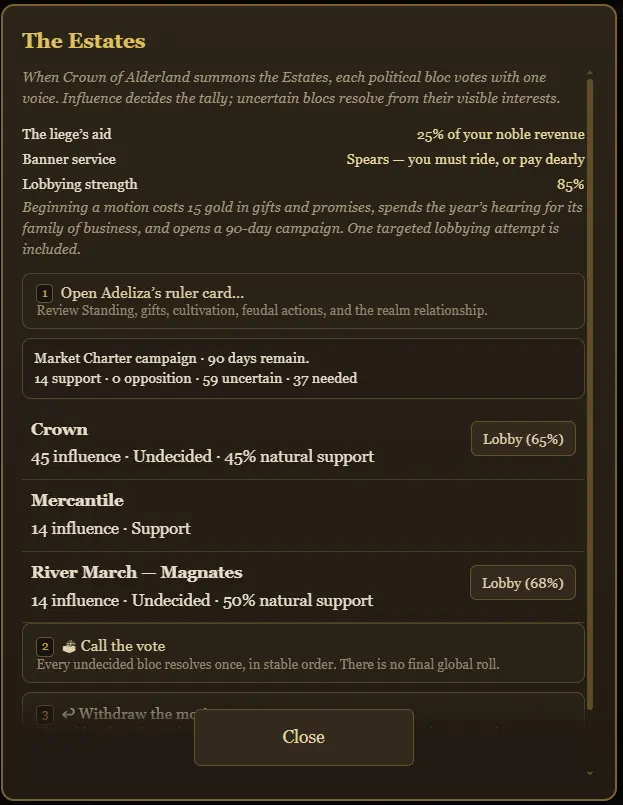
A sworn lord can seek emergency subsidy, scutage, levy relief, a market charter, confirmation of custom, consent before the liege changes obligations, or an Estates judgment on wartime powers. Each proposal has its own eligibility, cost, political interests, and result. Families of ordinary business can be heard once per year, while emergencies can force their way onto the agenda.
Beginning a proposal opens a 90-day campaign. Every political bloc takes a visible position based on its members and interests. An undecided bloc shows its natural support and the chance of a lobbying attempt, and influence sets the strict majority. When the vote is called, those bloc decisions are the result. There is no final hidden roll that can overturn the chamber the player just spent a season reading.
The catalog is moddable too. Policies, gates, posture rules, and outcomes live in data, so a conversion can replace the Estates' business instead of rewriting the parliament engine.
Tournament season arrives
Gentry on the noble path and landed rulers can now receive tournament invitations during spring and summer. They are uncommon occasions rather than a calendar that never stops, with separate ceremonies for gentry gatherings and the great tourneys of lords.
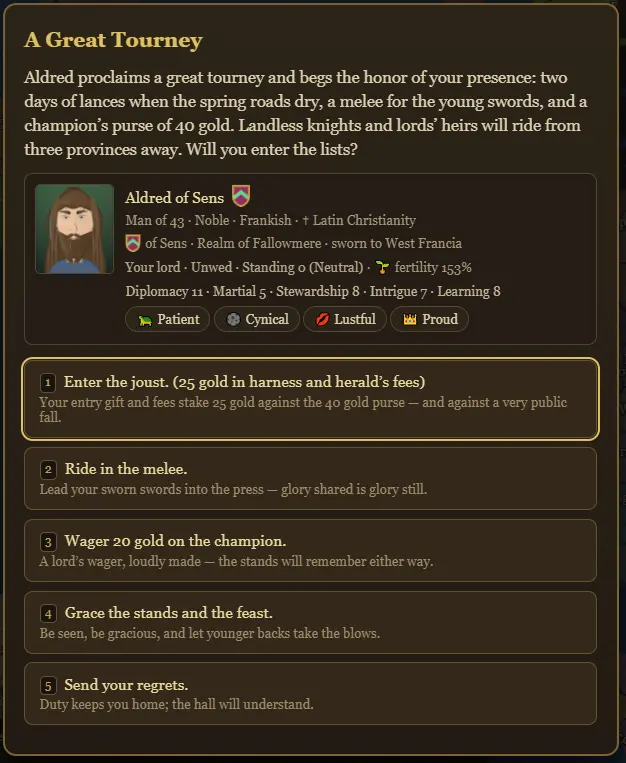
The joust asks for an entry purse and offers the greatest prize. The melee has no entry fee but still risks the press of weapons, a wager puts coin behind another champion, and attending the stands trades danger for the chance to honor the host. The exact ceremony and social choices adapt to the host's faith.
These contests use the character already built by the rest of the game. Martial skill, Brave or Craven temperament, relevant holdings, worn battle gear, and blessings all matter in the lists. Victory, defeat, injury, prize money, prestige, and Standing with the host return to the same life that arrived at the gate.
War stops hiding the bargain
The conquest picker now says why a target can be attacked. A de jure right held through a duchy, kingdom, or empire is named as such. A fabricated claim is shown as the single legal pretext it is. If an independent ruler has neither, the alternative is labelled plainly as a War of Aggression before any banners are raised.
Aggression opens territory without pretending to be free. The declaration preview lists the target and siege objective alongside its prestige, Common Voice, vassal, and foreign Standing costs. Repeated aggression under one ruler makes those political losses harsher and raises breakaway pressure. A conquered county then carries six years of Conquered Without Right, with lower tax and levy, weaker Common Voice, and more unrest.
Once war begins, its sheet keeps a campaign record: recent battles, troop losses, active effects, host strength, allied contributions, and live logistics. New personal, host, and whole-war events make battlefield discipline, desertion, allied withdrawal, occupation, and negotiation part of the campaign rather than invisible arithmetic.
The searchable Guide now explains claims, aggression, sieges, skills, roles, inheritance, settlements, and technology, with links from the screens where those rules matter. One-time orientations also appear as the family crosses into roles with new responsibilities.
A house is easier to steer
Long campaigns now have a few more ways to shape the family carrying them. A head aged fifty or older can hand the house to an eligible adult successor while both are still alive, after a review of the handover. The old head retires into the family record instead of requiring death to make room for the next playable generation.
New campaigns can begin with different family ages and circumstances rather than always opening at the same point in a life. The house itself can be renamed from the family screen. Resident unmarried siblings can be assigned to careers, enterprises, and equipment while they remain with the household, giving useful adult kin something to do before marriage or departure.
Large interfaces are easier to work with as well. Family trees gain search, branch controls, and jumps to important people. Conquest targets can be filtered and sorted. Work and enterprise lists can be grouped, searched, and ordered. Settings can bind permanent keys to semantic actions such as Work & Enterprises and daily focuses.
Interface, balance, and reliability notes
- Modding: Technology domains, traditions, effect caps, and the default starting bookmark can now be changed by runtime mods.
- House continuity: Female rulers use the correct female forms of their titles, and runaway family growth is bounded before browser saves become too large to store reliably.
- Economy: Orchards no longer require Seed Selection, a Press House earns a production-chain bonus beside a household Orchard, and peddlers now stock goods according to the buyer's station and purse with an occasional aspirational piece.
- Information density: Character, technology, enterprise, building, and item summaries use compact label-and-value rows in place of repeated boxed tables.
- Guide and list fixes: Guide topics open and scroll reliably, skill searches include what a skill affects, war filters fully hide excluded targets, and collapsed family-tree branches stay collapsed.
- Interface maintenance: The large interface source was split into four ordered files without changing play, making later work on panels and dialogs easier to isolate.
Fallowborn is a free browser grand strategy game by one developer, built openly with AI assistance. Source on GitHub.